

Abhishek Pandey ELE Times, Sub-Editor
Inside the architecture, platforms and security controls help enterprises coordinate AI agents, automate complex workflows, and move autonomous AI from experimentation into production.



The Importance of Orchestration: Issues Beyond Individual AI Agents
AI (Artificial Intelligence) will advance from a chatbot answering queries to one that can plan how to execute tasks, perform the jobs that software tools do, discover information, and run multi-stage workflows. The AI agents are capable of doing useful things with some oversight. But in a business workflow running across multiple systems, a specialised task or an approval stage requires more than a single agent.
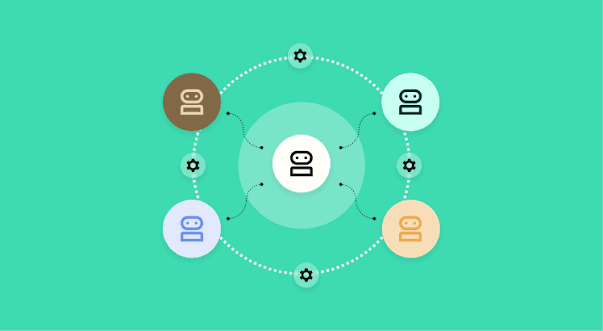
Enter AI agent orchestration. Orchestration is how you ‘align the agents, the model, your tools, data sources, and workflows’ so they accomplish your objective. Orchestration gives your system the ability to pass, control dependencies, maintain context, recover from failure and know when to call a human. That’s because building an agent makes it do the task; orchestrating it makes it part of a trusted end-to-end business process.
Inside the Architecture: How AI Agent Orchestration Works
Most orchestration systems consist of multiple interacting parts. The orchestrator “knows the objective, formulates or takes a sequence of steps, delegates work, and tracks results.” One or more agents execute the specific tasks in fields like research, data extraction, processing, document generation, or software operation.
It consists of a model layer for reasoning and language generation, a memory layer for storing relevant context, and a tools layer for enabling agents to interact with business applications and external systems. Monitoring and policy controls can keep actions within boundaries.
The flow could be a straightforward linear series of steps where one agent’s final result drives the next, or more flexible with the orchestrator determining the next steps based on intermediate results. Intelligent automation could retry a step if the output is validated, or bring in a human to take over if uncertain or risky.
The description Google Cloud gave of its Gemini agent shows this shift in focus. Here’s how Thomas Kurian, President and CEO, Google Cloud, explained, “You give it objectives, not instructions. You delegate an outcome and come back to finished work.”

This principle is key to orchestrating agents: instead of explicitly ordering all actions, people can ask an agent to do a task by defining an objective, and the agent will prepare the work, choose its tools, and organise the necessary actions to achieve it. Full autonomy remains a matter of available tech and permissions.
The Framework Race: Platforms Powering Enterprise AI Agents
When it comes to libraries, frameworks offer developers reusable parts to help construct and coordinate agents. These include support for defining workflows, tool calling, state management, agent communications, and integrations with external services.
LandGraph supports stateful, graph-based workflows. They can control the flow of execution and structure more complex workflows. The goal of the OpenAI Agents SDK is to enable developers to access the primitives necessary for high-level agent commands, tools, handoffs, and guardrails. The ADK from Google supports creation and orchestration of agents, while CrewAI abstracts the orchestration of agents and tasks into collaborative workflows. Llamalndex workflows, developers can create multi-step, event-driven applications that are event driven that have data and retrieve.
However, these two options are not necessarily always exactly the same. It may be a hard decision to make because it really depends on how you work and observe the setting where you will use it. Comparing the solutions for real workloads is the key. A framework does not also mean an enterprise is fully governed. There may also be a need for additional platform services or custom development for identity management, access control, audit logging, monitoring, and approval processes.
From Context to Continuity: How AI Agent Memory Works
Memory allows an agent to utilise information other than the provided prompt. An agent with no memory would need to be prompted to recall the same information each time or may forget key details along the way.
Short-term or working memory keeps information available during the current task. Long-term memory stores information for use over a series of sessions. Semantic memory encodes information (Facts and concepts); episodic memory documents relevant episodes or events. Some systems may additionally require storing reusable procedures/skills in procedural memory.
Memory must be carefully controlled. Too little information can reduce consistency, and excess will either make the system costlier, give the user information they do not require, or in some instances, reveal confidential information. Businesses need to have a policy in place regarding what is stored, for how long, and who accesses it and when.
Memory also should not be mistaken for model training. An agent can make use of its memory at runtime without modifying the existing model parameters. The right orchestration of memory, retrieval, permission, and context selection enables an agent to provide the right information for every task.
Connecting AI to the Real World: Tools, APIs and MCP
An agent becomes more valuable when enabled to integrate with systems outside its language model. Tools and APIs allow your agents to view records, perform database searches, update tickets, produce reports, and perform supported business actions.
Model Context Protocol (MCP) is an open protocol for describing how an AI app connects to external tools and context providers. MCP servers can expose tools, resources, and other functionality to MCP clients, helping users discover and reuse those integrations in an orchestration fashion.
Connectivity isn’t the same as authorisation. Just because you’ve given an agent the access it requires to do its job, it shouldn’t be making further decision-altering production data changes, approving payments, or sharing sensitive information-which will need further verification or human approval.
Additionally, organisations need to monitor the tools’ production, test inputs, trap bugs, and secure secrets. A successful API call does not mean that you made the right call or that the response is valid.
Single Agent or Multi-Agent System? Choosing the Right Approach
A single agent architecture is often appropriate when a task has a specific goal, few interdependencies, and a simple ordering of actions. It is typically more straightforward to test, monitor, and service.
A multi-agent system might be appropriate if the work is most naturally divided among specialists. For instance, a research agent might collect data, an analysis agent might examine the data, and a reporting agent might compile the final document. The orchestrator manages the handoffs and verifies if the combined result satisfied the criteria.
Though, the introduction of agents towards the system costs us some communication overhead, more model calls, inconsistencies, more difficult failure handling, and harder-to-debug systems. A multi-agent system could become costlier and more complicated to work with than a simpler system.
The moral of the story is not to over-architect. For most projects, start with the least complicated architecture that will do the work. Use specialised agents only where they provide a measurable increase in accuracy, scale, or performance.
Keeping Autonomous AI Under Control: Governance, Security and Observability
Enterprise orchestration should, therefore, not just accomplish a task. It should be used to decide who should do what, and on which resources. Ensure all tasks that should be done are done, that what should have been done is present, what was done, and how to verify or undo what was done.
Add: Least privilege permissions, runtime enforcement of policy, protected runtime environment audit and monitoring, and human approval gates. Observability might be even more important, as the failure can happen in different agents, tools, and systems rather than in a single model response.
ServiceNow announced with NVIDIA in October this year, identifying this as a problem. Jon Sigler, Executive Vice President and General Manager of AI Platform at ServiceNow, explained, “As AI agents take on more autonomous tasks, governance and security have to extend to everything they touch.”

ServiceNow Arc is generally available under the governance of the ServiceNow Super Intelligence Control Tower and the enforcement of the NVIDIA Open Shell. Further, it discusses the intended future integration of AI Passport with NVIDIA Open Shell and NVIDIA Blue Field enforcement layers. These supposed future features should not be described as generally available.
Airing similar views, Justin Boitano, Vice President of Enterprise at NVIDIA, said, “Enterprises are using AI agents to do real work, and that means policy has to be enforced everywhere an agent runs.”

Boitano’s point is that governance must live in the execution environment where the agents operate, not in some high level policy or, worse, an application-level configuration setting. Runtime enforcement can limit an agent’s access to systems and tools, even while it carries out its multi-step work.
From Experiments to Enterprise Deployment: The Challenges Ahead
When an orchestrator makes the leap from demo to production, it will need testing. This is because single agents might get inconsistent results, misinterpret directions, pick the wrong tool, or just fail if the service, they’re attached to is unavailable. Multi-agent systems magnify these problems when one agent passes on an invalid output.
Organisations should measure the rate of task completion, quality of output, latency, cost of operation, tool-call accuracy, and policy adherence. They should additionally check failure recovery, access limits, and the ability to withstand malicious instructions included in external content.
Cost management is also an issue. A workflow that fires off many large models, transmits too much context, or offloads too many subtask requests can rack up high costs. Model routing, caching, bounded retries, and well-defined stopping conditions can all improve things.
Begin by deploying use cases, defined success metrics, and permissions within your controls. As this technology matures and grows more reliable, however, an agent’s capabilities can increase while remaining under suitable human supervision.
What Comes Next? The Future of AI Agent Orchestration
AI agent orchestration is moving into more persistent agents, reusable skills, enhanced memory, standardised integrations, and tighter runtime controls. On the enterprise side, agent discovery, centralised monitoring, and policy enforcement are also becoming key focus areas.
The real goal is not to keep adding more agents, but to make the agents coordinate reliably across processes, and in a manner that is intelligent, auditable, and limited.
Business-wise, bringing that orchestration to bear will mean balancing the degree of system autonomy with the degree of system control. An information system equipped with a certain amount of autonomy and system control. An information system that combines smart planning, serviceable memory, strong tools, measurable delivery, and deployable controls is more likely to clear the pilot hurdles and create value.

