
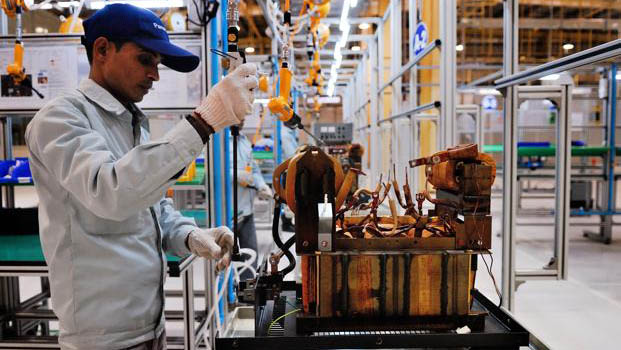
With an aim to promote local electronic manufacturing in India, the ministry of IT and electronics will approach the cabinet with a revised flagship incentive scheme for approval in the next few days, a top official said.
“We are reworking on MSIPS (Modified Special Incentive Package Scheme) that has to go to the Cabinet in next few days with an objective to fast-forward investments and incentives, simplify disbursement and also to rationalize categories,” IT Secretary Aruna Sundararajan said at an industry event on December 12, 2016.




M-SIPS (Modified Special Incentive Package Scheme) was launched in July 2012 for a three-year period and was revised to include white goods manufacturers and was extended till 2020.
The reworked policy is designed to speed up investments in India and simplify the expenditure process for the companies setting up units under the scheme.
Sundarajan said that ease of doing trade and steady financial schemes that the Goods & Services Tax (GST) would make possible, will globally attract manufacturers to India.
A study by advisory firm Ernst & Young (EY) released recommended that the mobile handset segment should be incentivized for local value-addition under the GST regime which can further drive the Centre’s ambitious ‘Make in India’ initiative.
The study by the US-based consultancy EY, along with Broadband India Forum (BIF), proposed that aids provided to handset manufacturers under the current allowance should also be extended to component manufacturing, in order to bring surplus venture into the country. In fact, incentives can be rewarded according to the local value addition done by a company, as per a proposed formula.
“Government has to do policy changes to create the necessary infrastructure, skills and R&D to bring whole manufacturing landscape into the country by providing incentives to set off local disabilities in the country,” E&Y Partner Bipin Sapra said.
India’s smartphone adoption is rising at a CAGR of 23%, and is expected to reach 688 million units by 2020 from nearly 388 million presently. Companies that locally assemble mobile phones get 11.5% duty benefit compared to those who import fully built phones, thus making phones within India a cheaper and more attractive proposition.
A recent IIM-Counterpoint finding puts local value addition at 6% and estimated that it could go up to 32% by 2020 after bringing most of the manufacturing processes locally.
While the government has said at multiple forums that it would want the current incentives to continue, the structure in which they will continue under the ambit of GST, is as yet unclear.
Handset industry’s growth faces uncertainty as the GST regime would do away with the current duty differential that mobile handsets makers avail. E&Y has proposed that under GST, incentives can be multiplied by a factor such that the total incentive is equivalent to the one currently available.
“The actual incentive amount can be enhanced with a multiplier (‘N’) to grant a benefit that is at least equivalent to the incentive available under the current regime with similar value addition, and higher incentives that can be granted when the local value addition in India is more,” the firm proposed.

