
HomeIndustryAerospace and DefenceISRO Launches the Most Powerful ‘Fat Boy’ GSAT-19 communication satellite began at...

ISRO Launches the Most Powerful ‘Fat Boy’ GSAT-19 communication satellite began at 3.58 pm on June 5, 2017

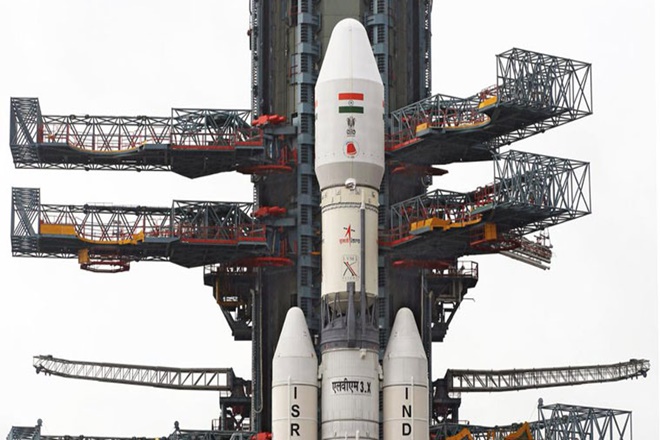
June 5, 2017, is going to be marked gold in the timeline of space victories in India. Indian Space Research Organisation, ISRO is adamant to grab the headlines with launching its most powerful rocket that will take along hi-tech communication satellite. Monikered as the ‘fat boy’, the Geosynchronous Satellite Launch Vehicle (GSLV-Mk III) is competent to fling four-ton weighing communication satellites into a higher orbit. It can also carry a 10-tonne capsule for a manned mission to space.

The 25 and a half-hour duration countdown for GSLV-Mk III carrying GSAT-19 communication satellite began at 3.58 pm on June 4, 2017. On June 5, 2017, GSLV-MK III will be carrying a 3,136 kg GSAT-19 satellite with communication transponders.

The GSAT-19 satellite is single-handedly equivalent of having an assemblage of six to seven communication satellites, those that has been launched in the past. Out of a constellation of 41 in-orbit Indian satellites, 13 are communication satellites.

The GSLV-Mk III is an emblem of ISRO’s adaptations of its rich knowledge in solid, liquid and cryogenic rocket propulsion technologies and marveling at simplifying designing in comparison to the Russian deliveries

“This (GSLV-Mk III) will increase our capability to launch satellites many fold,” said A S Kiran Kumar, chairman of ISRO. “It is completely indigenous.”

This also marks the end of further dependence on foreign launchers for its heavier satellites.

Till date, Arianespace, the French space agency, has been a preferred vendor that had launched ISRO’s communication and DTH TV telecast satellites.

The GSAT-19 satellite will also test technologies such as miniaturised heat pipe, fibre optic gyro, micro electro-mechanical systems accelerometer, Ku-band TTC transponder and indigenous Lithium-ion battery.

Space test

  • Name: GSLV-Mk III
  • Height: 43.43 metre
  • Vehicle diameter: 4.0 metre
  • Heat shield (payload fairing) diameter: 5.0 metre
  • Number of stages: 3
  • Lift off mass: 640 tonnes
  • Estimated cost: Around Rs 400 crore
  • Description: GSLV-Mk III has 2 solid strap-ons, a core liquid booster and a cryogenic upper stage. Designed to carry 4-tonne class of satellites into higher orbit or 10 tonnes to low earth orbit, twice the capability of GSLV Mk II
  • Capablity: GSLV Mk-III capable of launching satellites weighing close to 5,000 kg
  • Future ready: Paves way for manned missions into space. Currently, the US, Russia and China only have capability of launching manned missions
ELE Times Bureau
ELE Times Bureauhttps://www.eletimes.ai/
ELE Times provides a comprehensive global coverage of Electronics, Technology and the Market. In addition to providing in depth articles, ELE Times attracts the industry’s largest, qualified and highly engaged audiences, who appreciate our timely, relevant content and popular formats. ELE Times helps you build awareness, drive traffic, communicate your offerings to right audience, generate leads and sell your products better.

Related News

Must Read

Sasken Announces Hyderabad Center of Excellence to Scale Product Engineering and Digital Innovation

Hyderabad, India: April 16, 2026: Sasken Technologies Ltd. (BSE:...

Mission accomplished: Infineon technology proves reliable once again in space on Artemis II

Infineon's radiation-hardened semiconductors performed flawlessly on NASA's Artemis...

Bosch and Qualcomm expand collaboration to strategic ADAS solutions

Cockpit Computers: 10 million units delivered • High-performance solutions: Bosch...

Gartner Forecasts Worldwide Semiconductor Revenue to Exceed $1.3 Trillion in 2026

Semiconductor Revenue to Grow 64% in 2026 DRAM...

Directed Energy Systems: Where Capability Ends and Control Begins

by Sukhendu Deb Roy, Industry Consultant Key Takeaways The economics...

Boundary scan in combination with automotive applications for CAN-FD and LIN bus

Serial communication remains the backbone of electronic communication in...

Why Every EV & 5G Phone Could Soon Be Powered by Gujarat

In a move that cements India’s transition from a...


