
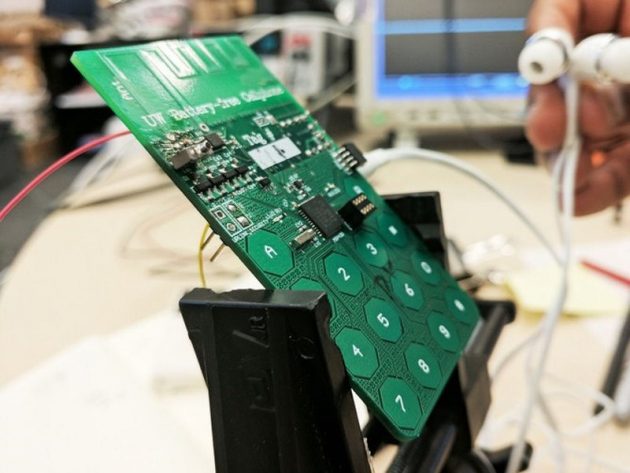
A team of faculty members and students at the University of Washington have developed the first phone that can operate without a battery to power its functions. The phone is made with commercially available components on a printed circuit board. (Photo via University of Washington, you can read the research paper here)
Communication is an essential part of life, and the telephone has likely been the greatest innovation in enabling communication between two remote locations, but ever since the need to speak on telephones went mobile, reliance on batteries can range from a minor inconvenience to a catastrophe. The phone developed by researchers at the University of Washington is a promising development in mobile communication and navigates around the possible perfect storm of an emergency scenario and a dead cell phone. It uses ambient power from surrounding radio signals, as well as from light because it has tiny photodiodes which capture light and convert it into an electrical current.




The user places a call by pressing capacitive touch buttons on the circuit board (which have the same layout as a regular phone), and according to the research team’s video, the phone transmits digital packets back to the cellular network of the base station from which it draws power, and they combine to form a phone number that is dialed using Skype. According to the team’s research paper, in its testing, the phone picked up power from radio frequency signals transmitted by a base station 31 feet away from the phone and was able to place a Skype Call to a base station that was 50 feet away. The team believes that their recent innovation, “…is a major leap in the capability of battery-free devices and a step towards a fully functional battery-free cellphone.”
At this stage in its development, the battery-free phone’s prototype has limited functionality, but it only consumes about 3.5 microWatts of power which is sufficiently supplied by ambient radio waves and light, for the purposes of this research. In Jennifer Langston’s article for UW News, co-author and electrical engineering doctoral student, Bryce Kellogg, is quoted as saying, “…the amount of power you can actually gather from ambient radio or light is on the order of 1 or 10 microwatts. So real-time phone operations have been really hard to achieve without developing an entirely new approach to transmitting and receiving speech.”
According to Langston, the team plans on improving the operating range and encrypting conversations, as well as trying to stream video on a battery-free cell phone by adding a visual display using low-power E-ink screens. This will obviously necessitate more power, and therefore a new approach to supplying the power needed to be based on the estimates of available power provided by Kellogg. As it stands, the University of Washington team has provided an intriguing proof-of-concept, as well as future directions for exploration and refinement, so now the world must wait to see if their revolutionary invention sparks an even greater change in the culture of mobile communication.
The team’s research was funded by the National Science Foundation and Google Faculty Research Awards.
To read the original article, visit here.

