
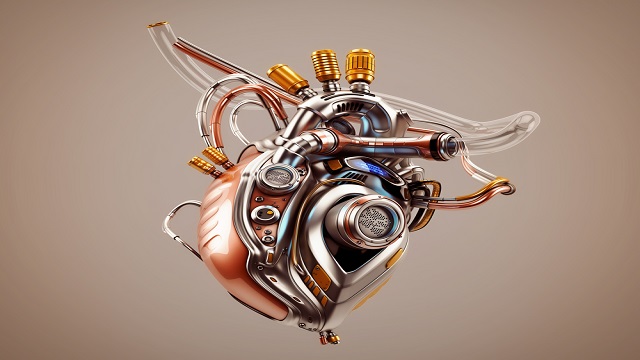
Technology has already become the necessity by transforming lives. Artificial organs are the big revolution in medical electronics. After decades of development, artificial organ products are now ready to enter the medical device market. Innovation makes our dreams real and will solve with time, the problem of shortage of human organ donors.
An artificial organ is an engineered device or tissue that is implanted or integrated into a human — interfacing with living tissue — to replace a naturalorgan, to duplicate or augment a specific function or functions so the patient may return to a normal life as soon as possible.




 Artificial organs today only have a few sensors. But in the near future, the next generation of artificial organs will have a myriad of embedded sensors to monitor the status of the patient, and more intelligence to take changes in physiology into account. The software that pilots these artificial organs must parallel engineering developments.
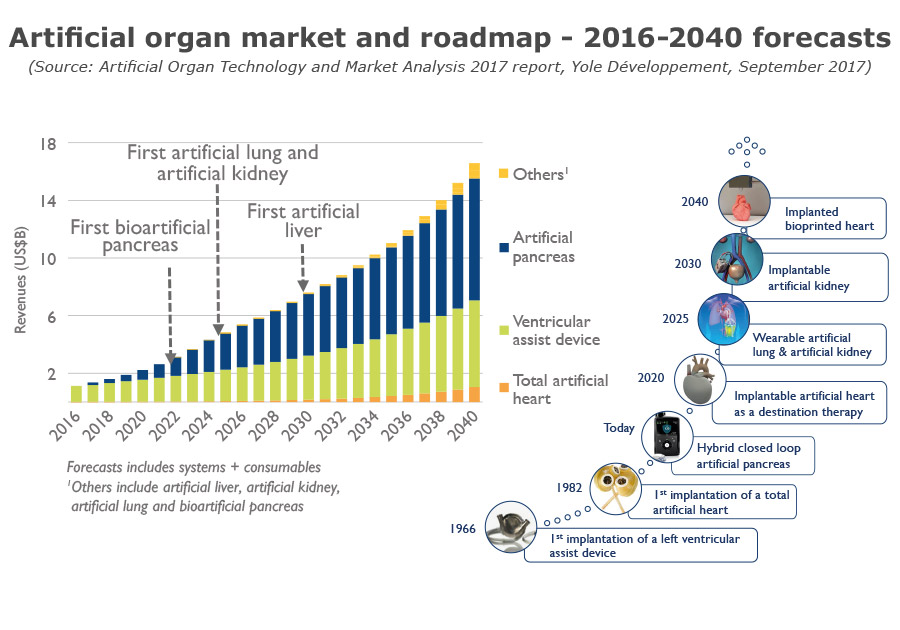
The artificial organ market will be worth US$1.3 billion in 2017 and its 20% CAGR over the next five years will see it grow to US$3.5 billion in 2022.
“This impressive growth is mainly driven by the exceptional growth of the artificial pancreas segment, showing a 49% CAGR between 2017 and 2022 in value”, comments Dr. Marjorie Villien, Technology and Market Analyst at Yole Développement. “The ventricular assist device market is mature and showing a 9% CAGR during this period. From its side, the total artificial heart market is still emerging. Its CAGR reaches 15% between 2017 and 2022”.
In the not-too-distant future, artificial organs made of biomaterials and living cells will replace failing human organs. This will render treatment techniques such as Renal Dialysis unnecessary, and patients will no longer have to wait years for a donor organ. This is the view of prof. Dimitrios Stamatialis, professor of (bio) artificial organs at the University of Twente.
Together with his research group, Prof. Stamatialis is working on the development of a portable artificial kidney. His long-term goal is to develop an implantable artificial kidney containing living kidney cells. He and his team of Twente-based scientists are also developing an artificial pancreas (for diabetes patients) and artificial lungs (for COPD patients), using the body’s own cells.
The artificial pancreas market will therefore experience a huge 49% compound annual growth rate (CAGR) over the next five years, to reach $1.3B in 2022. The next breakthrough to happen will come in 5-10 years, bringing artificial lungs and kidneys. The first commercially approved devices will be wearable systems such as the Wearable Artificial Kidney Foundation, Inc. (WAKFI) system. In the near future, the next generation of artificial organs will have a myriad of embedded sensors to monitor the status of the patient, and more intelligence to take changes in physiology into account.

