

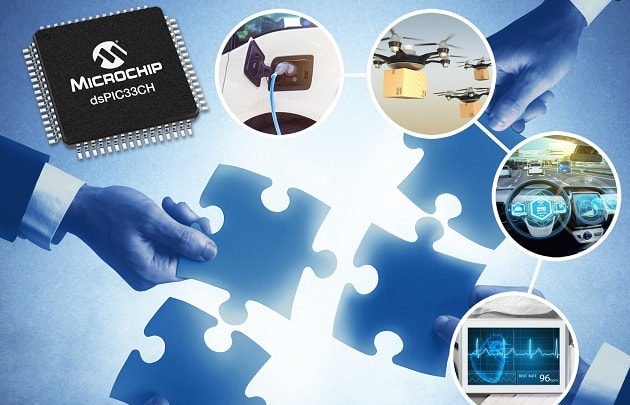
System developers designing high-end embedded control applications can benefit from a new Digital Signal Controller (DSC) with two dsPIC Digital Signal Controller cores in a single chip, now available from Microchip Technology Inc. The dsPIC33CH has one core that is designed to function as a master while the other is designed as a slave. The slave core is useful for executing dedicated, time-critical control code while the master core is busy running the user interface, system monitoring and communications functions, customised for the end application. The dsPIC33CH is designed specifically to facilitate independent code development for each core by separate design teams and allows seamless integration when they are brought together in one chip.
The dsPIC33CH family is optimised for high-performance digital power, motor control and other applications requiring sophisticated algorithms. This includes applications such as wireless power, server power supplies, drones and automotive sensors. For example, in a digital power supply, the slave core manages the math-intensive algorithms, while the master core independently manages the PMBus protocol stack and provides system monitoring functions, increasing overall system performance and responsiveness. Distributing the overall workload across two Digital Signal Controller cores in a single device enables higher power density through higher switching frequencies, leading to smaller components. The dsPIC33CH family was designed for live updating of the system, which is especially important for power supplies where firmware updates must be made with zero downtime.



In an automotive fan or pump, the slave core is dedicated to managing time-critical speed and torque control while the master manages the Controller Area Network Flexible Data rate (CAN-FD) communications, system monitoring, and diagnostics. The two cores work seamlessly together, enabling advanced algorithms to improve efficiency and responsiveness. In addition, each of the new cores in dsPIC33CH devices has been designed to provide more performance than current dsPIC DSC cores through 1) more context-selected registers to improve interrupt responsiveness; 2) new instructions to accelerate Digital Signal Processor (DSP) performance, and 3) faster instruction execution.
“Customers tell us one of their biggest challenges is integrating software from multiple teams where one team is focused on the time-critical control code and another is working on the rest of the application,” said Joe Thomsen, vice president of Microchip’s MCU16 business unit. “We created this dual-core product to simplify that software integration and optimise the performance for math-intensive applications.”
The dsPIC33CH family delivers unprecedented integration in a small 5 x 5 mm package and includes features such as CAN-FD communications. To reduce system costs and board size, advanced peripherals are available to each core including high-speed ADCs, DACs with waveform generation, analog comparators, analog programmable gain amplifiers and high-resolution Pulse Width Modulation (PWM) hardware. Having two cores, with dedicated peripherals, allows the cores to be programmed to monitor each other for functional safety reasons, facilitating robust system design.
Availability
The dsPIC33CH is available in eight package variants from 28 to 80 pins and as small as 5 x 5 mm. Memory sizes range from 64 to 128 KB of Flash.
The dsPIC33CH Curiosity development board, the dsPIC33CH PIM for motor control development boards, and the dsPIC33CH PIM for use with Explorer 16/32 boards are all available now.

