
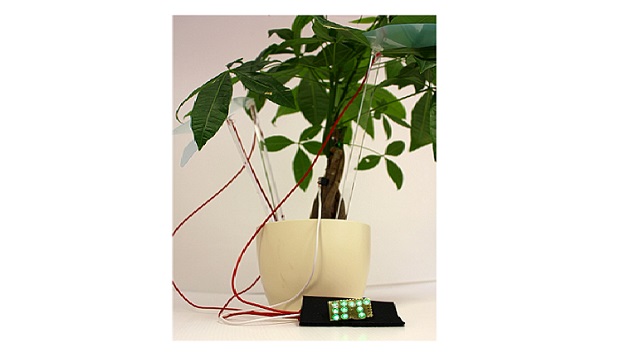
Italian Scientists have developed ways to generate power with living plants for lighting up LED bulbs, providing a “green” solution of sustainable power. The research was done by the team of roboticists and biologists at IIT-Istituto Italiano di Tecnologia in Pontedera in Pisa, Italy with the results published on Advanced Functional Materials.
The research, led by Fabian Meder, discovered that living plants can generate more than 150 Volts by a single leaf, which is enough to simultaneously power 100 LED light bulbs. Researchers also showed that a “hybrid tree” made of natural and artificial leaves can act as an innovative “green” electrical generator converting wind into electricity.




Based at Center for Micro-Bio Robotics (CMBR) of IIT in Pontedera, Italy, the research team aims to develop innovative methodologies, robotic technologies and new materials with the inspiration of the natural world. In the last study, the research team studied plants and showed that leaves can create electricity when they are touched by a distinct material or by the wind.
Certain leaf structures are capable to convert mechanical forces applied at the leaf surface into electrical energy, because of the specific composition that most plant leaves naturally provide. In detail, the leaf is able to gather electric charges on its surface due to a process called contact electrification. These charges are then immediately transmitted into the inner plant tissue. The plant tissue acts similar to a “cable” and transports the generated electricity to other parts of the plant. Hence, by simply connecting a “plug” to the plant stem, the electricity generated can be harvested and used to power electronic devices. IIT’s researchers show that the voltage generated by a single leaf may reach to more than 150 Volts, enough to simultaneously power 100 LED light bulbs each time the leaf is touched.
In the article, researchers additionally describe for the first time how this effect can be used to convert wind into electricity by plants. Therefore, researchers modified a Nerum oleander tree with artificial leaves that touch the natural N. oleander leaves. When wind blows into the plant and moves the leaves, the “hybrid tree” produces electricity. The electricity generated increases the more leaves are touched. Consequently, it can be easily up-scaled by exploiting the whole surface of the foliage of a tree or even a forest.

