
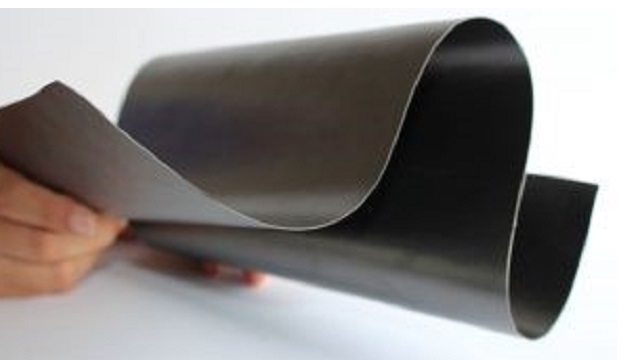
Researchers from the Fraunhofer Institute for Environmental, Safety and Energy Technology UMSICHT, Oberhausen, have developed a flexible and thin bipolar plate material for batteries which do not require sealing, making them vulnerable to leakage, and can be welded to create large plates if required.
Thicknesses can also vary, depending on the amount of graphene used for conductivity. “We can make plates that are so flexible that you can wrap them around your finger, as well as ones that are completely stiff,” said Dr Anna Grevé, department head at Fraunhofer UMSICHT.




To manufacture the plates in any required size, the commercially available polymers and graphites are used. They could be shaped after production and embossed to create flow fields for use in fuel cells.
Having flexible bipolar plates made of polymers mean that individual cells do not have to be connected as they currently are. This improves efficiency and manufacturing, compared with the typical cell architecture.
Conventional battery systems can consist of several individual cells, connected by wires. This makes them expense and time-consuming to produce but also means that hot spots can occur. Packaging the cells mean that the battery is bulked out with material that is inactive. Bipolar batteries address these issues by connecting the cells using flat bipolar metal plates. These however, can corrode and ones made of carbon-polymer composite have to be several mm thick.
By manufacturing bipolar plates from polymers that have been made electrically conductive, the thickness of the plates is less than conventional cells. There is also a saving of 80% in the material used, said Grevé. The material will not corrode and can be reshaped, allowing embossing for fuel cells. Unlike conventional bipolar plates, these can be welded for a strong, leak-free battery.
Whereas conventional plates require joints to be sealed, which can take up space but also become porous, this material can be welded together, seal-free and not allow gases or liquids to pass through.
Researchers are already able to produce sample quantities. The material, in various thickness, will be showcased at the Hannover Fair (1 to 5 April 2019).

