
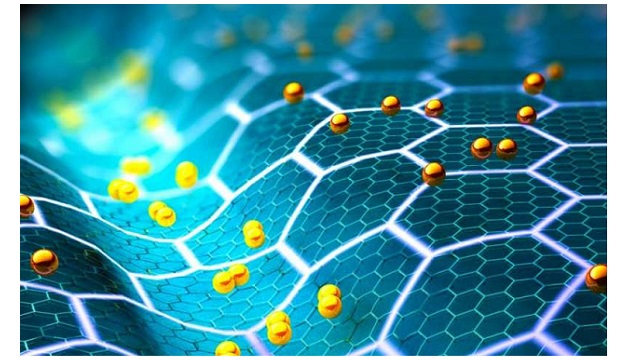
A research team of Columbia University has discovered a new technique to finely tune adjacent layers of graphene, lacy, honeycomb-like sheets of carbon atoms, to induce superconductivity. New insights have been provided into the physics underlying this two-dimensional material’s intriguing characteristics.
“Our work demonstrates new ways to induce superconductivity in twisted bilayer graphene, in particular, achieved by applying pressure,” said Cory Dean, assistant professor of physics at Columbia and the study’s principal investigator. “It also provides critical first confirmation of last year’s MIT results, that bilayer graphene can exhibit electronic properties when twisted at an angle, and furthers our understanding of the system, which is extremely important for this new field of research.”




In March 2018 researchers at the Massachusetts Institute of Technology reported a groundbreaking discovery that two graphene layers can conduct electricity without resistance when the twist angle between them is 1.1 degrees, referred to as the “magic angle.”
The team closely worked with the National High Magnetic Field user facility, Maglab, to reach the required high-pressures, for inducing superconductivity.
The researchers believe it may be possible to enhance the critical temperature of the superconductivity further at even higher pressures. The ultimate goal is to one day develop a superconductor which can perform under room temperature conditions, and although this may prove challenging in graphene, it could serve as a roadmap for achieving this goal in other materials.
Andrea Young, assistant professor of physics at UC Santa Barbara, a collaborator on the study, said the work clearly demonstrates that squeezing the layers has same effect as twisting them and offers an alternative paradigm for manipulating the electronic properties in graphene.
“Our findings significantly relax the constraints that make it challenging to study the system and gives us new knobs to control it,” Young said.

