
When we talk about energy storage, solar energy conversion, sensors and electronic devices, the first name we think is none other than ionic conductors. The materials conduct electricity through the ion passages rather than the electrons. Even the flexible Li-ion batteries, transparent touchscreens, stretchable display devices, loudspeakers and actuators are fabricated with these conductors.
The synthetic components, consisting of highly expensive, toxic and non-recyclable components containing indium tin oxide make these devices, which could potentially result in toxic hazards for humans and the environment.




Researchers have finally come up with eco-friendly alternatives for the current type of ionic conductors. An alternative green option based on organic silk and inorganic green laponite has been developed for display and wearables industry via flexible and eco-friendly ionics. Ultimately, there would be a wide range of applications within the field of flexible and wearable electronics.
“Materials scientists have long loved silk for its exceptional mechanical properties; it competes with steel in terms of the breaking strength, and spider webs are only stronger options when it comes to bending and stretching,” Alireza Dolatshahi-Pirouz, an Assistant Professor in the Department of Micro- and Nanotechnology at Technical University of Denmark, tells Nanowerk. “However, silk by itself is not a stable electrical conductor and that’s why we have designed our new material silk-laponite (SiPo) and shown that this property is achieved through the interaction of silk with laponite.”
Researchers generated an ionic conductor, exhibiting a host of highly desirable properties like better crystallinity, transparency, mechanical strength, recyclability, optical transparency, electrical sensitivity as well as chemical, thermal and dimensional stability. This ionic conductor is generated by embedding laponite into silk-based thin films.
With a promise of the technology’s low cost and its scalable manufacturing process, this could potentially make sensors suitable for mass production without compromising the environment.
A flexible touchscreen as well as a human motion sensor has been developed by researchers in order to demonstrate the practical applicability of their technology. The sensor readily conforms to the curvatures of the body and can measure motions from any part of the human body without any discomfort to the user.
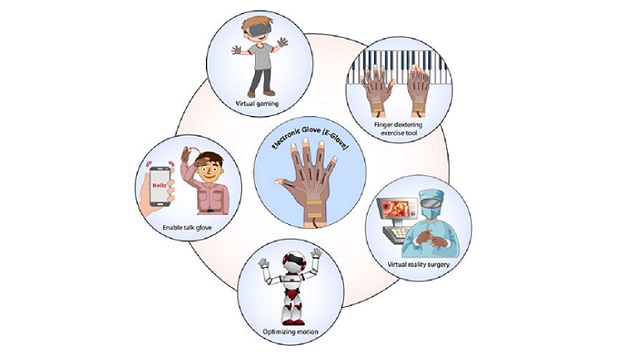
“Currently, we are developing a glove equipped with these flexible motion sensors,” notes Dolatshahi-Pirouz. “Supported by DTU’s Proof of Concept funding, in 10 months we will be ready with the first prototype of our E-glove, which would help surgeons to perform better in operations, translate sign language or even help the golfers improve their technique.”
Other application areas for wearable sensors could be to gather biological information from athletes during games; soldiers during missions; and musicians to improve their performances by helping them to gain the needed mastery of their subtle motions during strenuous activities.
“Protein-based electronics still require additional consideration to enable them to resist the many demanding phenomena in nature and within the human body,” cautions Dolatshahi-Pirouz. “Most of them quickly disintegrate in liquids and in response to various chemical and thermal stimuli. We will need to overcome these challenges before we could see their wide-spread use in daily life.”

