
MagnaChip Semiconductor Corporation (“MagnaChip”) (NYSE: MX), a Korea-based designer and manufacturer of analog and mixed-signal semiconductor products, announced hat it now offers a 0.13 micron BCD process with improved performance to help automotive power semiconductor designers build more competitive products.
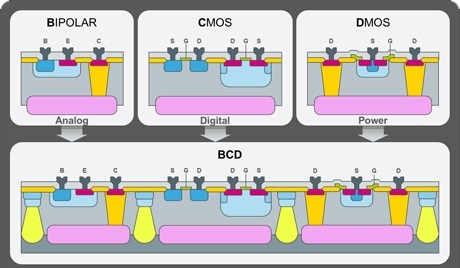
BCD (Bipolar-CMOS-DMOS) is a process technology that combines three different process technologies onto a single chip: Bipolar for analog signal control and CMOS (Complementary Metal Oxide Semiconductor) and DMOS (Double Diffused Metal Oxide Semiconductor) for digital signal control and high-power handling, used primarily for power semiconductors.




In particular, the process announced has been certified as Grade-1 under AEC-Q100, a reliability standard for automotive electronics and, therefore, is suitable for diverse automotive power semiconductors — including motor driver ICs, BMSs (Battery Management Systems) and DC-DC ICs. With the introduction of this process, the company plans to launch targeted marketing activities to attract more automotive semiconductor designers as customers.
Driven by the adoption of electric vehicles, the automotive semiconductor sector – including power products – is projected to see considerable growth over the next five years. According to IHS Markit technology research, now a part of Informa Tech, the automotive semiconductor market is forecasted to grow from $42 billion in 2019 to approximately $60 billion in 2023.
The MTP (Multi-Time Programming) IP applied to this newly enhanced 0.13 micron BCD process technology enables a chip to be reprogrammed at least 1000 times, a desirable feature for power semiconductors that require repeatable memory programming, such as motor driver ICs, power management ICs and level shifter ICs. Also, unlike the previous 0.13 micron BCD process technology, which requires additional photo layers to realize MTP IPs, this new 0.13 micron BCD process does not require additional photo layers as a result of IP design optimization.
By virtue of no additional layers, MagnaChip’s new 0.13 micron BCD process could allow its customers to reduce cost and shorten the “time-to-market.”
YJ Kim, Chief Executive Officer of MagnaChip, commented: “Along with the rapid growth of the automotive power semiconductor market, demand is rising for foundry technologies with the highest possible reliability and cost competitiveness. Thanks to our BCD know-how and manufacturing expertise, I believe MagnaChip is more than capable to be the leading service provider in the growing automotive power semiconductor market.”
Source – IHS Markit technology research, now part of Informa Tech, Pure Play Foundry Market Tracker, 2019. Results are not an endorsement of MagnaChip Semiconductor. Any reliance on these results is at the third-party’s own risk.
For more information, visit www.magnachip.com

