
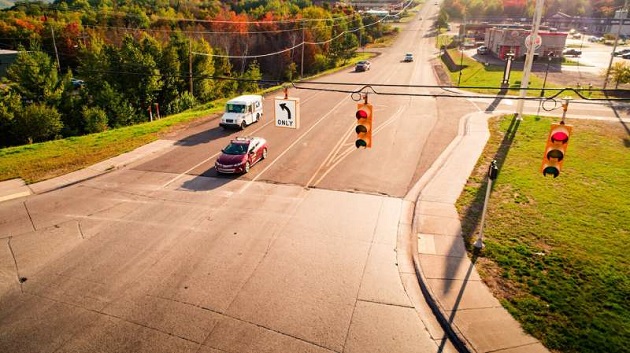
Imagine you’re driving up a hill toward a traffic light. The light is still green so you’re tempted to accelerate to make it through the intersection before the light changes. Then, a device in your car receives a signal from the controller mounted on the intersection alerting you that the light will change in two seconds—clearly not enough time to beat the light. You take your foot off the gas pedal and decelerate, saving on fuel. You feel safer, too, knowing you didn’t run a red light and potentially cause a collision in the intersection.
Connected and automated vehicles, which can interact vehicle to vehicle (V2V) and between vehicles and roadway infrastructure like traffic signals and stop signs (V2I), promise to save energy and improve safety. In a new study published in Transportation Research Part B, engineers from Michigan Technological University propose a modeling framework for V2V and V2I cooperative driving.



Cooperative driving helps cars and their drivers safely and efficiently navigate. The framework uses an eco-driving algorithm that prioritizes saving fuel and reducing emissions. The automated algorithm calculates location-based traffic control devices and roadway constraints using maps and geographic information. The research is led by Kuilin Zhang, associate professor of civil and environmental engineering and affiliated associate professor of computer science at Michigan Tech, along with Shuaidong Zhao ’18, now a senior quantitative analyst at National Grid.
For the past three years, Houghton, Michigan, has been home to roadside units installed on five of the city’s traffic signals that make V2I communication possible. Zhang conducted a simulation analysis using real traffic signal phasing and timing messages from the Ann Arbor connected vehicle test environment and plans to expand testing in the Houghton area.
“The whole idea of cooperative driving automation is that the signals in the intersection tell your car what’s happening ahead,” Zhang said. “The sensor at the intersection can benefit all connected vehicles passing through the intersection. The automated eco-driving algorithm improves the driving decisions of the connected and automated vehicles.”
The simulation results show that the cooperative automated eco-driving algorithm saves energy—7% under light traffic and 23% under heavy traffic along the corridor.
“The stop and go, stop and go, it may use a lot of energy,” Zhang said. “The concept of eco-driving incorporates how the vehicle makes driving decisions using data not only from vehicles in front of it, but also with information given from a traffic signal.”
Zhang’s model pulls in high-definition (HD) maps, which use a connected vehicle’s hardware and software to provide down-to-the-centimeter accuracy in navigation. HD maps incorporate multiple types of environmental sensing: long-range radar, lidar, camera footage, short/medium-range radar and ultrasound.
Zhang said for autonomous driving, it’s important to know landmarks to control the car’s driving, as well as hill grades; using a hill to slow or accelerate a car can also increase energy savings. It’s easy to conserve energy on a straight highway; on busy arterial streets with traffic and stoplights, energy conservation isn’t so simple. On city streets, Zhang and Zhao’s online predictive connected and automated eco-driving model considers traffic control devices and road geometry constraints under light and heavy traffic conditions.

