

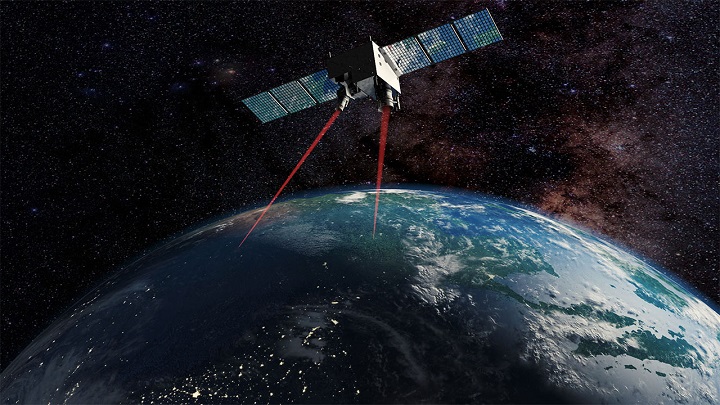
In the first step towards developing quantum satellite technology, the Indian Space Research Organisation (ISRO) recently successfully demonstrated a technology enabling secure communication between two buildings that were 300 metres apart using free-space Quantum Comm Technology.
“This is a major breakthrough for SAC (space applications centre) engineers who have demonstrated quantum comm between two buildings on March 19. Today, advanced computers can break encryption and future strategic communication will need quantum communication. Every country will need this and we have demonstrated it,” Sivan said.



The technology will be useful for a range of strategic sectors ranging from defence to digital money transactions, among other things and ISRO has plans for extending this to satellites as well.
Just last month, a team led by Prof Urbasi Sinha had demonstrated a similar technology that was developed as part of the Quantum Experiments using Satellite Technology (QuEST) project. In that case, the communication was between two structures that were only 50 metres apart.
As per the report, Working on quantum cryptography — Encrypting a message in a way nobody can read it at the quantum (minimal level of a unit in physics) level — the scientists had demonstrated the ability to share this secret key “safely” to another building.
QuEST, carried out by RRI’s Quantum Information and Computing (QuIC) lab, is India’s first project on satellite-based long-distance quantum comm. Started in 2017, QuEST is being implemented in collaboration with ISRO.
However, Sivan said: “While we are working with others on quantum technology, the demonstration we did last week was a technology developed at SAC. The most important thing is that we will be able to extend this to the satellites given that it is a free space quantum technology. That will be a quantum jump.”
He did not immediately elaborate more on the technology stating that the space agency will be making a formal announcement soon. On whether the SAC technology also uses QKD (Quantum Key Distribution), Sivan said: “Yes.”
According to Isro, a number of key technologies were developed indigenously to accomplish this major feat, which included the use of indigenously developed NAVIC receiver for time synchronization between the transmitter and receiver modules, and gimbal mechanism systems instead of bulky large-aperture telescopes for optical alignment.
The demonstration has included live videoconferencing using quantum-key-encrypted signals. This is a major milestone achievement for unconditionally secured satellite data communication using quantum technologies, ISRO said.
“The Quantum Key Distribution (QKD) technology underpins Quantum Communication technology that ensures unconditional data security by virtue of the principles of quantum mechanics, which is not possible with the conventional encryption systems,” an ISRO statement read.
Stating that conventional cryptosystems used for data-encryption rely on the complexity of mathematical algorithms, ISRO said the security offered by Quantum Communication is based on the laws of Physics. “Therefore, quantum cryptography is considered as ‘Future-proof’, since no future advancements in the computational power can break quantum-cryptosystem,” the space agency said.
The free-space QKD was demonstrated between two line-of-sight buildings within the campus. The experiment was performed at night, in order to ensure that there is no interference from the direct sunlight.
“The experiment is a major breakthrough towards ISRO’s goal of demonstrating Satellite-Based Quantum Communication (SBQC), where ISRO is gearing up to demonstrate the technology between two Indian ground stations,” the space agency added.

