HomeElectronicsSensorsFlow Sensors that are Ultra Sensitive

Flow Sensors that are Ultra Sensitive

A team of scientists at the University of Massachusetts Amherst has developed the thinnest and most sensitive flow sensors, which could have significant implications for medical research and applications.

The findings pave the way for future research on all-electronic, in-vivo flow monitoring in investigating ultra-low-flow life phenomena that is yet to be studied in metabolism processes, retinal hemorheology, and neuroscience.

Flow sensors, also known as flowmeters, are devices used to measure the speed of liquid or gas flows. The speed of biofluidic flow is a key physiological parameter but existing flow sensors are either bulky or lack precision and stability.

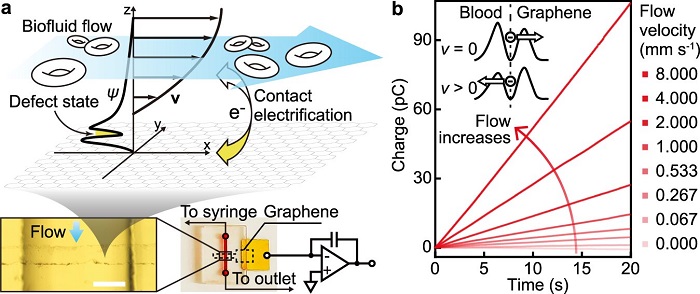
The new flow sensor developed by the UMass Amherst team is based on graphene, a single layer of carbon atoms arranged in a honeycomb lattice, to pull in charge from the continuous aqueous flow. This phenomenon provides an effective flow-sensing strategy that is self-powered and delivers key performance metrics higher than other electrical approaches by hundreds of times.

The graphene flow sensor can detect flow rate as low as a micrometer per second, that is, less than four millimeters per hour, and holds the potential to distinguish minimal changes in blood flow in capillary vessels. The performance of the graphene flow sensor has been stable for periods exceeding half a year.

The device his team created is the first one to be self-powered and high-performance, and it holds the potential to be implanted for long-term biofluidic flow monitoring. The most straightforward application, maybe in healthcare.

To implant, a micro flow monitor like the one his team developed in a small blood vessel is much simpler and safer than existing flowmeters, which are not suitable for low-flow measurement and need to be installed in a larger blood vessel.

Scientists and doctors may find it useful for their research and clinical applications, such as monitoring the blood flow velocity in deep-brain vessels to understand the functioning of neurons that control the flow of blood.

Graphene is the key material in the development of the sensor. The unique combination of intrinsic properties of graphene, such as ultra-high sensitivity, ultra-low electrical noise, minimal contact electrification with aqueous solutions, outstanding stability in chemical and mechanical behaviors, and immunity to biofouling, work together to induce the high performance of the flow sensor.

The next step includes integrating the flow sensor into a self-sustained flow monitoring device and exploring the application of the device in healthcare.

ELE Times Research Desk
ELE Times Research Deskhttps://www.eletimes.ai
ELE Times provides extensive global coverage of Electronics, Technology and the Market. In addition to providing in-depth articles, ELE Times attracts the industry’s largest, qualified and highly engaged audiences, who appreciate our timely, relevant content and popular formats. ELE Times helps you build experience, drive traffic, communicate your contributions to the right audience, generate leads and market your products favourably.

Related News

Must Read

INFAC Develops 800V-to-48V Power Conversion Technology to Targets Higher EV Efficiency

South Korea's INFAC Corporation has introduced a new 800V...

Why India Needs Smarter and More Standardised EV Charging Infrastructure

India's rapidly expanding network of electric-vehicle chargers still faces...

Rare-Earth-Free EV Motors: How India Could Reduce Dependence on Critical Magnet Materials

India is exploring new electric-motor technologies that may help...

India Tightens EV Localisation Rules, Putting Traction Motor Technology in Focus

India is moving toward higher domestic manufacturing of key...

Indian Army Launches AASHVAST Lab to Detect Chinese Components and Cyber Threats

To strengthen the security of military drones and identify...

AeroVironment Receives First International Order for LOCUST Laser System

AeroVironment announced that it received the first international order...

Covenant Introduces a Mass-Produced Cruise Missile Called Anthem

US defence firm Covenant has unveiled its Anthem, a...

The DRDO’s SHIELD Programme Focused on Microwave & Drone-Electronics Testing

India is developing its directed energy capability through the...

1.10 Lakh Crore Indian Defence Technology Pipeline Approved

The DAC (Defence Acquisition Council) of India approved, to...

India Will Open AI Labs for Sri Lankan Army

India is now helping Sri Lanka set up an...



