
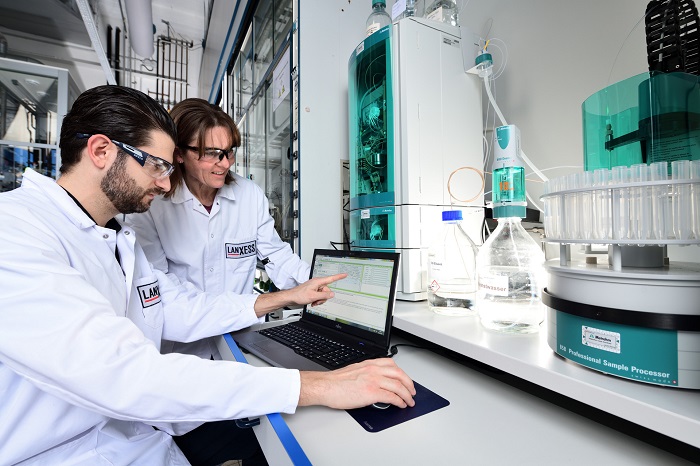
The specialty chemicals company LANXESS has upgraded its Lewatit K 7333 ion exchange resin for oxygen removal for use in the electronics industry. The improved polymer matrix in conjunction with a modified formula now enables production of the palladium-doped, strongly alkaline anion exchanger with the very highest degree of purity, allowing it to be used for producing ultra-pure water (UPW) for semiconductor manufacture and wafer polishing. Only specially purified ion exchangers are used here for producing water with an extremely high level of purity.
As one of the leading manufacturers of ion exchange resins, LANXESS aims to acquire additional customers in the electronics industry with this novel product and strengthen its market position.




Successful product upgraded for pioneering applications
For some years now, the ion exchanger has been successfully deployed for the catalytic removal of oxygen from process water. “The oxygenated water flows through a filter that is filled with Lewatit K 7333. In the counterflow, hydrogen is passed through the filter. The palladium-doped ion exchanger acts like a catalyst here. Hydrogen and oxygen react in a ‘cold combustion’ process to form water,” explains Hans-Jürgen Wedemeyer, Manager Technical Marketing in the Liquid Purification Technologies (LPT) business unit at LANXESS.
A further application for Lewatit K 7333 is the catalytic removal of H2O2 (hydrogen peroxide) without the need for hydrogen. This technology is increasingly being used for producing ultra-pure water. The even higher-quality ultra-pure water produced in this way is needed because the residual content of ions for the ever-smaller module intervals in the semiconductor industry is specified in the ppt/ppq range. The TOC (total organic carbon) content should ideally be at the limit of detection. “Water purity requirements are becoming ever more exacting in response to the enhancement and refinement of the modules, which means that it is increasingly important that the particle count in the nanometer range are stronger decreased,” says Wedemeyer.
To achieve these very low values, a special UV lamp is used. The lamp oxidizes any residual organism in the water to produce CO2. The ion exchangers then absorb these in the form of hydrogen carbonate. One adverse side effect during treatment with ultraviolet light is the formation of hydrogen peroxide (radiolysis) which can damage the downstream ion exchangers. This leads to increased levels of TOC and the formation of particles in the downstream ion exchangers. Palladium-doped Lewatit K 7333 eliminates the hydrogen peroxide formed through radiolysis right down to the low ppt range, with the ion exchanger itself responsible for only very minimal contamination with TOC, particles, or residual ions.
“This technology is already being used in many new plants and is being retrofitted in existing plants. This is why we are expecting increased demand for our Lewatit K 7333 ion exchanger so that we can meet the ever-stricter requirements regarding water purity in the semiconductor industry,” says Wedemeyer.
Ion exchangers – indispensable for wet-chemical procedures in the electronics industry
UPW is an indispensable ingredient in the processing of wafers or the complex, wet-chemical procedures involved in photolithography in the production of microelectronics and nanoelectronics. Such processes are used to manufacture semiconductor components such as computer processors, memory chips, light-emitting diodes (LEDs), liquid crystal (LC) and LED displays, and photovoltaic modules. UPW is also used in microsystems technology for manufacturing and processing miniaturized mechanical components for micropumps, micromotors, and microvalves, for example. Ultra-pure water is an important prerequisite for preventing or removing deposits or impurities from delicate structures right down to the nanometer range that would otherwise result in production faults and indefensibly high reject rates. “As electronics become increasingly small, the quality requirements regarding UPW continue to increase,” says Wedemeyer.

