
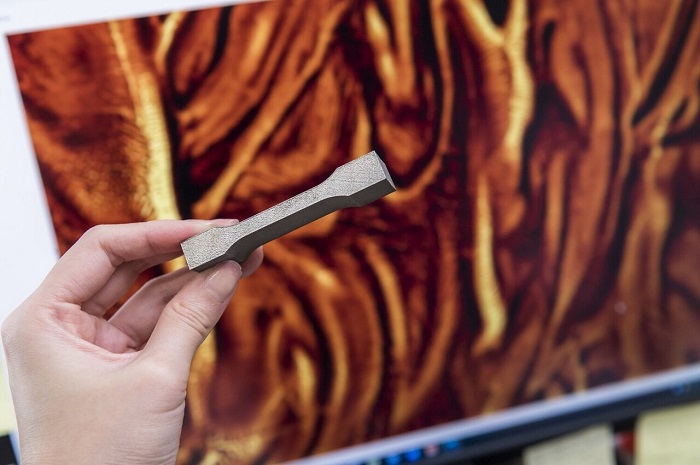
A study led by scientists from City University of Hong Kong (CityU) has successfully developed a super-strong, highly ductile and super-light titanium-based alloy using additive manufacturing, commonly known as 3D printing. Their findings open up a new pathway to design alloys with unprecedented structures and properties for various structural applications.
The research team was led by Professor Liu Chain-Tsuan, University Distinguished Professor in the College of Engineering and Senior Fellow of CityU’s Hong Kong Institute for Advanced Study (HKIAS). Dr. Zhang Tianlong, a postdoc in the Department of Materials Science and Engineering (MSE), conducted the experiments. Their paper, to which President Way Kuo of CityU also contributed, was published recently in the prestigious scientific journal Science, titled “In situ design of advanced titanium alloy with concentration modulations by additive manufacturing.”




3D printing: Not just a shaping technology
Most people consider 3D printing as a revolutionary technology that can produce machine parts with complex shapes within just one step. “However, we unveiled that it has important potential in designing materials rather than simply designing geometries,” said Dr. Zhang, who completed his Ph.D. at CityU under Professor Liu’s supervision earlier this year.
Metallurgists tend to think that a lack of uniformity in alloy components is undesirable because it leads to bad properties, such as brittleness. One of the key issues in the additive manufacturing process is how to eliminate this inhomogeneity during fast cooling. But Dr. Zhang’s previous modeling and simulation study found that a certain degree of heterogeneity in the components can actually produce unique and heterogeneous microstructures that enhance the alloy’s properties. So he tried to put these simulation results into reality by using additive manufacturing.
Designing unique microstructures
“The unique features of additive manufacturing provide us with a greater freedom in designing microstructures,” Dr. Zhang explained, who is also the first author of the paper. “Specifically, we have developed a partial homogenisation method to produce alloys with micrometer-scale concentration gradients with the aid of 3D printing, which is unachievable by any conventional methods of material manufacturing.”
Their proposed method involves the melting and mixing of two different alloy powders and stainless steel powders using a focused laser beam. By controlling parameters like the laser power and its scanning speed during the 3D printing process, the team successfully created the non-uniform composition of the elements in the new alloy in a controllable way.
“In addition to the use of additive manufacturing, the composition of the two powder mixture is another key to creating the unprecedented lava-like microstructures with a high metastability in the new alloy,” said Professor Liu. “These unique microstructures give rise to the supreme mechanical properties, allowing the alloy to be very strong but ductile, and in light weight.”
While stainless steel is generally 7.9 grams per cubic centimeter, the new alloy is only 4.5 grams per cubic centimeter, resulting in around 40% lighter weight. In their experiments, the titanium alloy with lava-like microstructures exhibited a high tensile strength of ~1.3 gigapascals with a uniform elongation of about 9%. It also had an excellent work-hardening capacity of over 300 megapascals, which guarantees a large safety margin prior to fracture, useful in structural applications.
“These excellent properties are promising for structural applications in various scenarios, such as the aerospace, automotive, chemical, and medical industries,” said Professor Liu.
“As the first team to use 3D printing to develop new alloys with unique microstructures and properties, we will further apply this design idea to different alloy systems to further explore other properties of the new alloys,” he added.

