
Azobenzene-functionalized liquid crystalline materials can be operated by remote light-stimuli without complicated circuits or parts and thus are attracting great attention in fields such as human interfaces, haptic devices, and miniaturized soft robots.
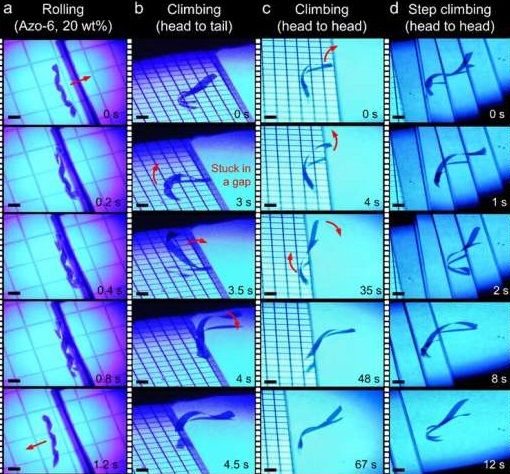
Demonstrating light-induced movements in the soft robot, previous studies had reported crawling and walking motions, with large friction observed. Recently, rolling motion in cylindrical and multi-turn helical soft robots have been reported which reduces friction by adopting rolling resistance, much like the wheel. However, rolling is not an effective strategy for climbing stairs as we experience it in everyday life.




Researchers went further and implemented torsional motion of the single-turn helix-shaped soft robot that maximized the helical diameter per unit length, a factor closely tied to the height of the obstacle that a soft robot can overcome. In the case of a single-turn helix, the torsional soft robot rolling on the ground comes in contact with only one and two points, while a single end of the soft robot is able to reach over the obstacles. With these observations, it was clear that a single-turn helix would be an effective design that would minimize rolling resistance while maximizing the height reach of the soft robot.
To overcome obstacles, the torsional soft robot would need to lift up its entire body upon a single contact point. Molecular engineering has allowed researchers to demonstrate step climbing torsional soft robots, as well as large velocity per body length (0.15 BL/s) within lightweight bodyweight (0.2 mg). Seven different azobenzene-based molecular switches were examined to program molecular alignment and crosslink density as liquid crystalline polymers. Most previous studies controlled the crosslink density of polymers by incomplete curing or addition of non-crosslinkable monomers. However, these strategies increase dangling molecules, which cannot transfer the photogenerated stress of molecular switches. By varying the molecular length of molecular switches, researchers could control the crosslink density without increasing dangling chains. Hence, both high Young’s modulus (>2 GPa) and photogenerated stress (>1 MPa) are achieved. This helps soft robots maintain high coil height and enables them to lift up the entire body with one contact point upon the substrate. Finite-element analysis simulation also helps to understand the locomotion mechanism of torsional soft robots.
The researchers also optimized the temperature condition of viscoelastic soft robots in relation to the glass transition temperature. In a glassy state, the velocity of soft robots increased at higher temperatures as softer materials are easier for shape-reconfiguration. However, the opposite is observed in a rubbery state. At too high a temperature, soft robots cannot generate enough stress and dissipate photogenerated stress, illustrating the importance of viscoelasticity in polymer-based soft robots.
Through this work, new torsional soft robot design can expand the potential of soft robot application in various fields where stronger actuation or high reach is needed while augmenting our fundamental knowledge of structure-property relationship in light-driven soft robots.

