
HomeNewsIndia NewsAdvancing Quantum Sensor for Bio applications with a collaborative work

Advancing Quantum Sensor for Bio applications with a collaborative work

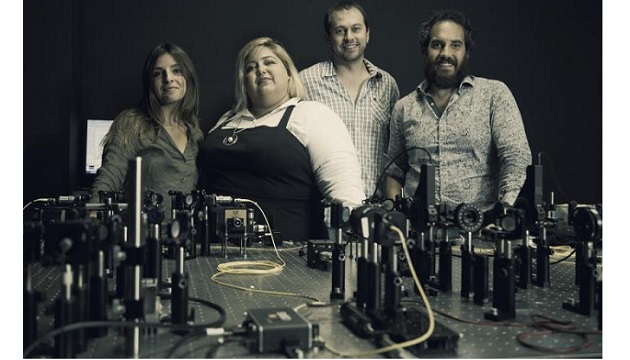
A research team at Università degli Studi Roma Tre has shown that quantum light can be used to track enzyme reactions in real time. The researchers developed a setup that allowed them to control the light at the level of a single photon. This made it possible to use low illumination without disrupting the enzymes, with the potential to achieve improved sensitivity. The capability to address the sample directly allowed dynamic tracking with higher resolution.

The researchers used their new technique to track changes in the chirality of a sucrose solution due to activity of an enzyme known as invertase. Tracking the chirality — the ability of a given molecule to rotate the polarization of light — provides information that can be used to determine how many molecules of sucrose have been processed by the enzymes. Control of the probe at the quantum level demonstrated the potential for reducing invasiveness while optimizing sensitivity at the same time.


“This work is just one example of what quantum sensors could do,” research team leader Ilaria Gianani said. “Quantum sensors could be used to optimally use light for countless applications, including biological imaging, magnetic field sensing, and even detection of gravitational waves.”

“Key to our success was a collaboration between quantum physicists, who know how to deal with photons, and biologists, who know how to deal with biological systems,” Gianani said. “This collaboration wouldn’t have been possible without the supervision of professor M. Barbieri, principal investigator of the Quantum Optics Group.”

The researchers said there are some technological aspects to address before their approach could be applied to the tracking of enzymatic reactions. For example, light losses are a strong limiting factor, but the team hopes that its work will help spur technology development that could address this problem. This preliminary effort, bringing together methods of quantum physics and biology, could be a step toward the full development of quantum sensors for biological systems.

ELE Times Research Desk
ELE Times Research Deskhttps://www.eletimes.ai
ELE Times provides a comprehensive global coverage of Electronics, Technology and the Market. In addition to providing in depth articles, ELE Times attracts the industry’s largest, qualified and highly engaged audiences, who appreciate our timely, relevant content and popular formats. ELE Times helps you build awareness, drive traffic, communicate your offerings to right audience, generate leads and sell your products better.

Related News

Must Read

Keysight Introduces RF Signal Analyzers

New analyzers help engineers capture more signal behavior with...

Murata Brings 3D EM and Thermal Simulation Models to Ansys

Murata Manufacturing Co., Ltd. announces a new collaboration with...

Microchip’s Nantes Facility Achieves QML Class Y Certification

Microchip Technology announces that its Nantes facility in France expands...

Vishay Intertechnology Releases New 1 A, 2 A, and 3 A Gen 7 1200 V FRED Pt Hyperfast Rectifiers in SMPC HV Package

Reducing Switching Losses and Increasing Efficiency, Devices Combine Low...

Rohde  and Schwarz Leads GCF 3GPP NR-NTN Validation with Record Test Cases

Rohde & Schwarz is driving the commercialization of 5G-based...

ROHM Launches AG16xFNxx Series MOSFETs for Automotive 48V Power Supply Systems

ROHM develops the “AG16xFNxx Series,” a lineup of 80V...

STMicroelectronics High-Performance Vibration Sensor offers an alternative to Piezosensors

Industrial-grade vibration sensor delivers the latest wide-bandwidth and...

Bosch Accelerates Automation and Robotics Drive

Advance robotics and the dynamic growth of humanoid systems...

AI server Boards are Boosting at ASMPT SMT Solutions

Solutions, a global technology manufacturer of hardware and software....

Bosch Introduces Third-Gen Silicon Carbide Chips for EV

As India accelerates its transition to electric mobility, the...

