
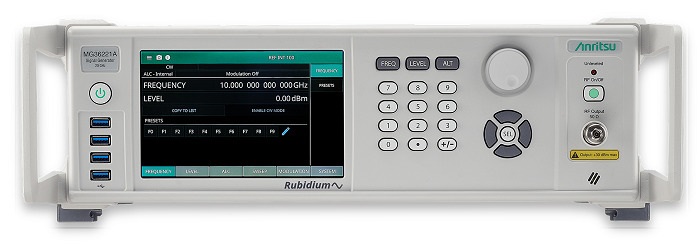
Anritsu Company introduces the Rubidium signal generator family that delivers outstanding signal purity and frequency stability, even at high output power levels, across a broad frequency range of 9 kHz to 43.5 GHz. Coupled with built-in, easy-to-use, at-location frequency and power calibration capability, Rubidium offers exceptional overall utility and long-term value in a broad range of commercial and military/aerospace measurement applications.
Groundbreaking Performance




Signal purity is critical to a wide range of measurement applications ranging from radar testing to testing of ADCs and DACs. The Rubidium signal generator offers groundbreaking low single sideband (SSB) phase noise of -136 dBc/Hz (typical) and -140 dBc/Hz (measured) at 10 GHz and 10 kHz offset that is unmatched in the industry. Coupled with best-in-class harmonic and spurious performance, the Rubidium signal generator enables customers to make measurements with better accuracy.
The Rubidium™ offers an order of magnitude with better frequency stability compared to other signal generators that use an OCXO based reference. This exceptional frequency stability is achieved either by an optional internal Rubidium™ reference or by locking the signal generator’s time base to a 1 PPS reference from an optional internal GNSS/GPS atomic clock receiver.
Utility, Ease of Use, and Long Term Value
The Rubidium™ signal generator features built-in, on-site frequency, and level calibration that is easily accessible with the touch of a button on the GUI interface. This feature ensures customer level, accurate frequency desired, timesaving, enhancing convenience, and increasing instrument availability. An Anritsu CW USB power sensor is required for onsite level calibration. An internal GNSS/GPS atomic clock receiver or ultra-stability rubidium timebase option is required for onsite frequency calibration.
The Rubidium’s AM, FM/PM, and pulse modulation capabilities enable a wide range of complex analog modulated signals. An internal low-frequency generator can generate seven different waveform types to modulate the carrier. Additionally, simultaneous modulation of AM/FM, AM/PM, or FM/Pulse is possible to generate complex modulation waveforms such as chirps. Broad signal simulation capabilities are built into the signal generator for pulsed radar testing.
The Rubidium is housed in a 3U chassis with a 7-inch touch screen on the front panel with a traditional keypad/dial interface. A wide range of options is offered to achieve optimum cost-to-function and measurement flexibility.
Wide Range of Applications
The Rubidium™ signal generator can be used in a variety of applications. It is ideal for applications that require low phase noise such as testing radar subsystems, up/down converters, or high-speed ADCs/DACs. The signal generator is well suited for conducting nonlinear measurements without additional filters because of the exceptionally low harmonic, subharmonic, and non-harmonic performance at standard and high output power levels. They can be used for a variety of interference measurements, as a signal source to test devices and systems, and as a frequency reference in calibration and metrology labs.
For more information, visit www.anritsu.com

