
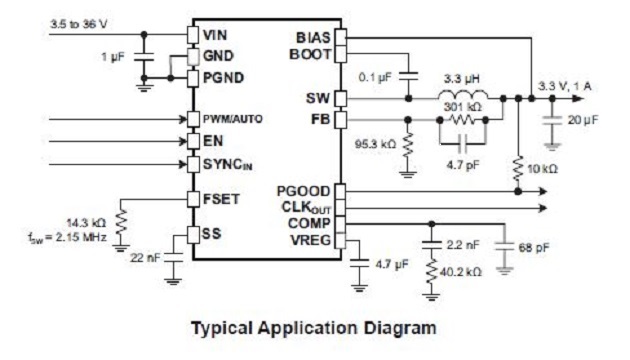
Automotive AEC-Q100 qualified, it will operate with inputs from 3.5 to 36V (withstanding 40 V load dump surge) and draws just 8μA when maintaining 3.3 or 5.0V on the output.
Everything except for passives are included to create a PWM regulator with ±1.5% output voltage accuracy over the operating range of -40°C to 150°C.




Called ARG81800, two versions are available: 500 mA and 1 A, to allow smaller PCBs for lower power systems as the components can be optimised for size.
“The 150°C Tj operating capability makes the ARG81800 suitable for harsh under-hood and industrial automation applications,” claimed the firm.
ARG81800-block-diagPWM switching frequency can be programmed over 250kHz to 2.4MHz to avoid interfering with AM broadcasts and to trade efficiency, cost and size. PWM frequency dithering and controlled switch node slew-rate is included to reduce EMI (EMC) signature, and there is a SYNCIN pin to feed this regulator from an external clock. Even when synchronised to an external clock, frequency modulation is applied to dithered the switching signal to reduce EMI.
“The ARG81800 is at the forefront of technology,” claimed Allegro marketing director Mark Gaboriault. “We embraced the opportunity to offer solutions that make it easier for our customers to meet their EMC requirements, including reference designs and design notes.”
A similarly dithered CLKOUT pin allows interleaving and synchronisation with associated regulators (using their synchronisation inputs),
If Vin decays and the duty cycle reaches its maximum, the ARG81800 will automatically fold back its PWM frequency to extend the duty cycle and maintain output voltage.
Soft-start is included, as is soft recovery from drop-out. A feedback voltage monitor that produces an open-drain ‘power good’ signal, and there is an enable pin to shut the converter off to 1μA.
In no load or very light load conditions, the chip switches from PWM mode to a low-power mode to keep chip current low – this is where the 8μA figure comes from. A pin is provided to fix the chip in PWM mode – and it will be in PWM all the time an external clock source is used.
Loop compensation is external to tune response over different PWM frequencies.
Protection includes: pulse-by-pulse output current limit, short-circuit hiccup mode, bootstrap capacitor open, bootstrap capacitor short, Vin under-voltage lockout, Vout over-voltage and thermal shutdown.

