
HomeElectronicsEmbeddedCAN FD quadruplet for M.2 interfaces

CAN FD quadruplet for M.2 interfaces

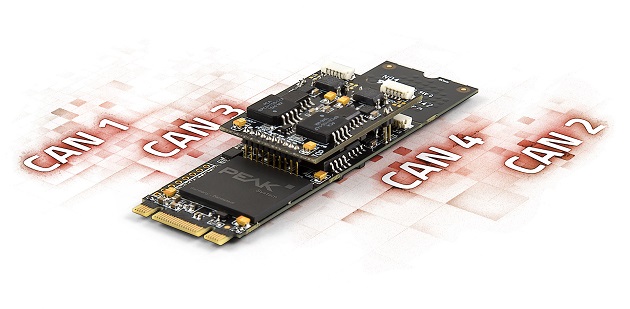
PEAK-System expanded its CAN FD product line with the PCAN-M.2 Four Channel. Thanks to the mounted expansion board on the main board, four CAN FD channels are available for computers. Connection to CAN buses is made using the supplied connection cables with D-Sub connector. Each CAN FD channel can transmit a maximum of 64 data bytes of a CAN FD frame at bit rates of 20 kbit/s up to 12 Mbit/s. Each channel is also galvanically isolated up to 300 volts and can be terminated.

As with the single and dual channel versions, the PCAN-M.2 Four Channel card in form factor 2280 has a contact strip with B+M key. The length can also be adjusted from 80 to 60 millimeters via a predetermined breaking point. The card can be used on any motherboard size from Mini-ITX to E-ATX. Thus, the plug-in card is suitable for desktop and industrial PC cases of various sizes. Especially for embedded systems, such as those found in motor vehicles, railways, and aircraft, the CAN FD interface is ideal due to its size and compactness.


Device drivers are available for the operating systems Windows (10, 8.1, and 7) and Linux. The programming interface PCAN-Basic, an API for the development of applications with CAN and CAN FD connection, and the monitor software PCAN-View are included in delivery.

For more information, visit peak-system.com.

ELE Times Research Desk
ELE Times Research Deskhttps://www.eletimes.ai
ELE Times provides a comprehensive global coverage of Electronics, Technology and the Market. In addition to providing in depth articles, ELE Times attracts the industry’s largest, qualified and highly engaged audiences, who appreciate our timely, relevant content and popular formats. ELE Times helps you build awareness, drive traffic, communicate your offerings to right audience, generate leads and sell your products better.

Related News

Must Read

What is the Future of Embedded Systems?

In the next five years, the embedded landscape will...

India Targets 50% Semiconductor Self-Sufficiency by FY35

In a major push toward technological sovereignty, India is...

Silicon Photonics: Breaking the Bandwidth Barrier in AI Computing

Introduction: When Data Movement Becomes the Bottleneck Artificial intelligence now...

PLC, PAC, and Industrial PC Architectures for Automation

Navigating the New Era of Industrial Control Systems Introduction Industrial automation...

Optics and Silicon Photonics: The Next Data Highway Inside Chips

For more than five decades, the semiconductor industry has...

Neuromorphic Engineering & Edge AI: The Future of Intelligent Computing

Artificial Intelligence is rapidly transforming industries, but traditional AI...

Ensuring Reliable AI in Safety-Critical Systems: Challenges and Engineering Solutions

Introduction: When AI Decisions Carry Real-World Consequences In safety-critical environments,...

Nanometer Nanotubes for Future Electronics

1nm molybdenum disulfide tubes expand nanotube science beyond carbon Researchers...

Scientists discover a Quantum Effect that Eliminates Batteries

Tiny defects inside a quantum material may hold the...

India’s Electronics Boost: SMT Expansion and Strategic Localization

India's electronics manufacturing and design ecosystem marks a major...

