
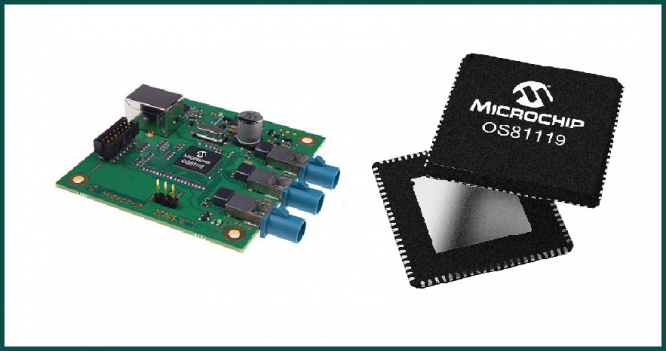
The newest (INIC) from Microchip Technology Inc. enables automotive manufacturers and tier one supplier to incorporate Media Oriented Systems Transport (MOST) networks in a daisy-chain configuration on coaxial physical layer with the support of full-duplex communication, in addition to a ring topology. With a full-duplex daisy-chained network, a single cable segment is sufficient to connect two adjacent devices in the network, reducing cables and connectors for the back channel on each network connection. It also eliminates the return wire connecting the last node of the network to the first. This reduces wiring and component count resulting in lower system costs as well as potential weight savings that can impact Corporate Average Fuel Economy (CAFE) goals and other fuel efficiency regulations.
Using Microchip’s OS81119 INIC allows customers to simplify the network architecture of automotive in-vehicle infotainment systems by using integrated coaxial physical layer (cPHY), optical physical layer (oPHY), daisy-chain topologies or creative hybrid combinations. Customers currently using MOST150 systems can also rapidly migrate to new topologies or daisy-chain additional nodes with little hardware and software redesign.




“This is the first time customers can create an MOST150 network using a daisy-chain configuration,” said Dan Termer, vice president of Microchip’s Automotive Information Systems business unit. “MOST networks are a proven standard used in more than 200 car models across all major OEMs. Continuous innovation, as shown with this new device, now makes MOST even more cost-effective.”
Besides an integrated cPHY, a USB 2.0 high-speed user interface is also part of the OS81119 INIC. This integration further reduces system component count, driving down overall costs. Time to market can be improved when using the USB standard and corresponding standardised MOST Linux Driver. Additionally, utilising an open-source Linux operating system and driver for the OS81119 helps customers reduce cost. By using the standard Application Programming Interfaces (APIs), customers can also minimise the risk of application issues.
MOST technology is the choice of many automobile manufacturers and tier one suppliers for in-vehicle networking. It specifically targets infotainment and telematics applications such as smart antennas, head units, amplifiers, digital clusters, rear seat entertainment, Advanced Driver-Assistance Systems (ADAS), driver/passenger information systems and public transportation infotainment and information systems. For more information on this device see: www.microchip.com/OS81119
Development support
The OS81119 is supported by the following tools and software:
- MOST NetServices V3.2.x
- MOST Linux Driver
- Microchip’s Unified Centralised Network Stack (UNICENS)
- K2L OS81119 USB Application Board
- MOST150 Slim Board family
- K2L OptoLyzer MOCCA compact 150c and 150o
- K2L INIC Explorer and Microchip Automotive Target Manager (MATM) with OS81119 configuration files and software
- K2L MediaLB bus analyser
Availability
The OS81119 is offered in a QFN88 package. Devices are available today in volume production in 10,000 unit quantities. To purchase products mentioned in this press release or obtain additional information, contact any Microchip sales representative or authorised worldwide distributor.

