

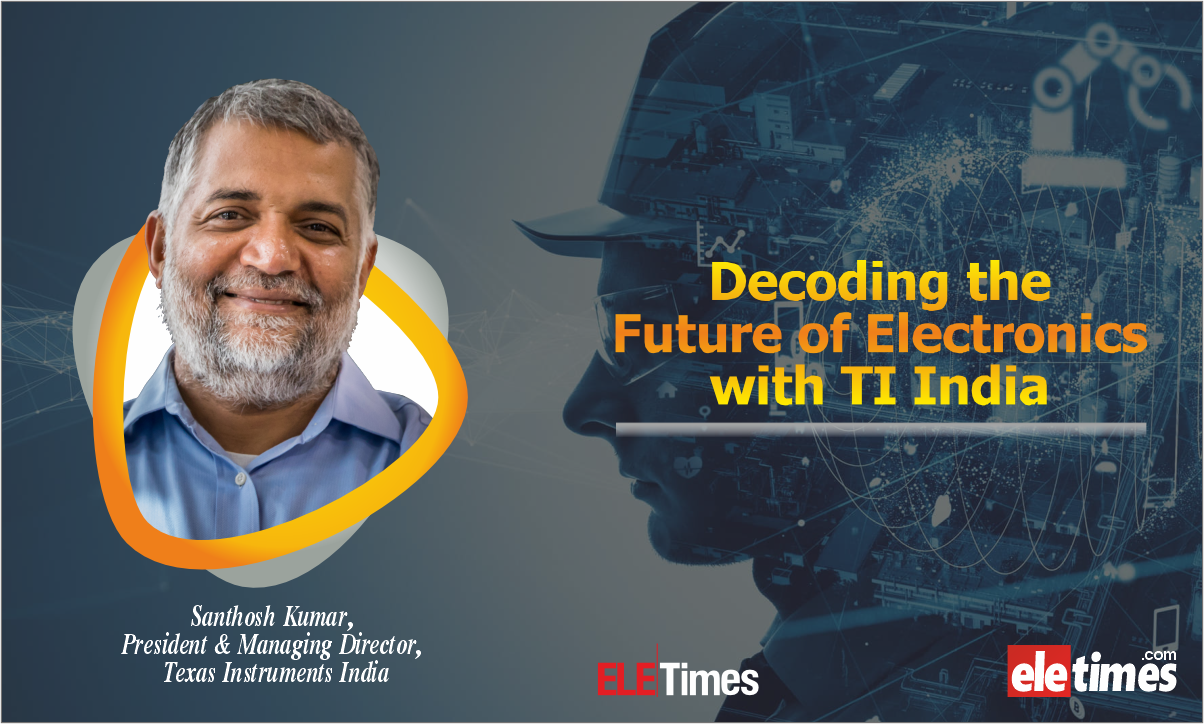
In an exclusive conversation with Kumar Harshit, Technology Correspondent, ELE Times, Mr. Kumar details how TI is leading the charge in creating a safer, greener, and smarter world through technology contributions from right here in India and shares his perspective on the future skill sets required for electronics engineers to thrive in the age of artificial intelligence.
Santhosh Kumar, President & Managing Director of Texas Instruments India, discusses the core themes of safety, sustainability, and innovation and outlines the transformative role of AI in shaping the next generation of engineering talent.



Here are the excerpts from the conversation:
ELE TIMES: Given the increasing focus on road safety, particularly for two-wheelers, how is TI leveraging technology to create safer and smarter vehicles?
Santhosh Kumar: Two-wheeler safety is critical, as the rider is the most exposed. We focus on leveraging simple, easy-to-deploy sensing technologies to solve real-world problems. For example, ensuring the side stand is retracted before the vehicle moves is a simple technique, often solved with magnetic sensing connected directly to the engine control. Moving to more advanced safety, we utilize radar and multiple sensors to provide warnings for both sides of the road. We also integrate technology that can help slow or stop a vehicle automatically if the car in front suddenly brakes, even if the rider isn’t fully alert. The goal is to either give the vehicle control to avoid a fatal accident or empower the rider with timely warnings.
ELE Times: TI emphasizes collaboration and community-driven innovation. How important are industry events like Electronica in deepening your relationship with the engineering ecosystem?
Santhosh Kumar: These events are vital for two key interactions. First, our engineers love to work directly with the engineers of our customers. This technical bond is the strongest foundation for creating relevant products. Events like this provide an apt platform for us to build and deepen those relationships. Second, we connect with decision-makers and purchase teams to demonstrate the affordability and worthiness of a product as a feature for mass-market products. Ultimately, innovation doesn’t happen in isolation; it comes from interaction within a community and ecosystem, making these floors essential.
ELE Times: The world is demanding greener technology. Could you outline TI’s commitment to sustainability, both in terms of internal operations and product design?
Santhosh Kumar: We are sensitive to the work we do both inside and outside our factories. Internally, we have a goal to be 100% powered by green energy by 2030, and we are well past 30% today. Furthermore, over 90% of our operational waste is diverted from landfills.
From a product design perspective, we are very sensitive to ensuring our products take up the smallest area and consume the least amount of power. We are always optimizing to create the smallest possible MCU with minimal energy consumption. This approach allows our customers to create products that are inherently greener than they would otherwise have been.
ELE Times: Can you introduce us to TI’s innovative product line in the Power management area?
Santhosh Kumar: We are heavily focused on smart, intelligent systems. A prime example is our Battery Management Systems (BMS), designed and developed in collaboration with engineers in India, ensuring power is used exactly as intended. We have several compelling demos on motor control. India has billions of motors running today, and we are showing how to make them run most efficiently, with the lowest possible cost, without sound, and without losses. You can witness these technologies integrated, such as in our two-wheeler demonstration, combining BMS, motor control, and security features. Given the huge push towards industrial and factory automation in India, we are also showcasing numerous technologies adapted for smarter, more secure, and greener appliances for the 1.4 billion people consuming electricity.
ELE Times: Beyond the automotive and industrial sectors, what are the emerging market segments in India that you see offering significant opportunities for TI’s growth?
Santhosh Kumar: We operate across five core segments, and we see growth in all of them. After automotive and broad industrial (which includes medical electronics, where a lot of Indian innovation is happening), the third key segment is personal electronics. This includes audio, video, and speech, where AI is bringing about a tremendous influx of smarter systems. The large bandwidth and data flow driving these first three segments necessitate our involvement in the communication segment, which forms the backbone. Finally, the enterprise business is the fifth segment. We are seeing customers, product creators, and applications happening in all five areas across India.
ELE Times: Texas Instruments India has been a pioneer for over 40 years. Could you detail the strategic role TIPL plays in driving cutting-edge innovation for TI’s global business units?
Santhosh Kumar: TI India is an important entity to our worldwide business. We have architects, product definers, system engineers, analog and RF designers, and application engineers who manage businesses and contribute to the entire value chain. In fact, many TI’s new products today have a significant contribution from India, including end-to-end product development. We have world-class infrastructure, including labs, benches, and all the necessary equipment in Bangalore, to enable us to contribute to the success of these global products.
ELE Times: Can you share a recent technological breakthrough from TI and define what innovation means to Texas Instruments in the context of solving real-world problems?
Santhosh Kumar: A recent breakthrough we are very excited about is our Gallium Nitride (GaN) solutions. For instance, deploying GaN in two-wheeler chargers can shrink their size by one-third compared to existing technology and significantly reduce power consumption and heat generation due to lower leakage.
To us, innovation extends beyond laboratory research; it is about how we look at real-world problems and use technology to solve them, ultimately enhancing people’s quality of life. We have both an opportunity and a responsibility to improve the lives of eight billion people while preserving the planet.
ELE Times: Talent acquisition is key to sustained innovation. What initiatives does TI India have in place to attract and nurture the next generation of core engineering talent?
Santhosh Kumar: Our strategy is to hire the bright talent directly from campuses, which accounts for 80% of our hiring. To feed this pipeline, we have programs like our Women in Semiconductor and Hardware (WiSH) program, which engages female students beginning in their second year of college. This program provides hands-on experience in core engineering disciplines, including design, testing, verification, and validation. We want to allow a large segment of the population to understand what it means to do core engineering and be a part of world-class product development right here in India.
ELE Times: As a leader who has seen India’s electronics landscape evolve over decades, what is your key message for the industry today?
Santhosh Kumar: The key message is to adopt the technologies happening globally and bring in innovation through new products. This is a tremendous opportunity for India to lead the wave of innovation, to solve real-world problems. We can bring innovation in manufacturing, product development, and applications that lift the quality of life for our people here and for the eight billion people worldwide. With the current energy in the ecosystem and the influx of new players, India can play an important role in driving innovation.

