
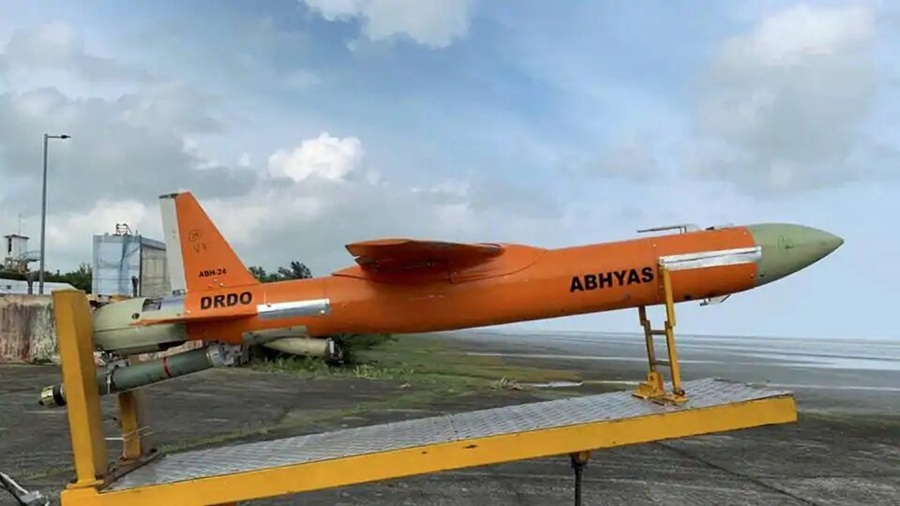
India’s Defence Research and Development Organisation (DRDO) continues to push the boundaries of indigenous defense innovation, with the DRDO Abhyas standing as a testament to this progress. Abhyas, a High-speed Expendable Aerial Target (HEAT) system, is designed to simulate realistic threat scenarios, providing the Indian Armed Forces with a cutting-edge platform for testing and training. True to its Sanskrit name, which means “practice,” Abhyas plays a crucial role in enhancing combat readiness by replicating aerial threats, enabling the evaluation of missile defense systems and other critical military technologies. Engineered to meet the evolving demands of modern warfare, this advanced UAV underscores India’s commitment to self-reliance in defense technology.
Overview of DRDO Abhyas
The DRDO Abhyas UAV is an expendable, high-speed aerial target that replicates a range of aerial threat profiles. It is an essential tool for training and testing defense personnel and weapon systems. The platform has been developed by the Aeronautical Development Establishment (ADE), a key laboratory under DRDO. The primary objective of Abhyas is to provide a cost-effective and reliable solution to simulate enemy aircraft, cruise missiles, and UAVs during military drills and equipment testing.




Technical Specifications
Abhyas boasts state-of-the-art technology, making it a versatile and efficient platform for defense applications. Key technical features include:
- Airframe and Propulsion:
- The UAV features a lightweight composite airframe designed for high-speed maneuvers.
- It is powered by a small gas turbine engine capable of achieving high subsonic speeds, ensuring realistic simulation of aerial threats.
- Guidance and Navigation:
- Abhyas employs a Micro-Electro-Mechanical Systems (MEMS)-based Inertial Navigation System (INS) integrated with a Flight Control Computer (FCC).
- This configuration allows the UAV to perform autonomous flight along pre-programmed paths with precision.
- Launch and Recovery:
- The system utilizes a rocket-assisted take-off mechanism, ensuring a quick and efficient launch.
- Parachute-based recovery enables the safe retrieval of the UAV after mission completion.
- Payload Capabilities:
- Abhyas can be equipped with various payloads, including radar cross-section (RCS) augmentation devices, infrared (IR) flares, and electronic warfare (EW) systems, enhancing its ability to mimic diverse threat profiles.
Development and Testing Milestones
The development of Abhyas has been a systematic process involving multiple stages of testing and validation:
- Initial Trials:The first successful trial of Abhyas was conducted in 2012, establishing proof of concept for its design and functionality.
- Subsequent Improvements:Over the years, DRDO has incorporated several enhancements, such as improved booster configurations and advanced augmentation systems for better simulation capabilities.
- Recent Achievements:In June 2024, DRDO conducted six consecutive trials at the Integrated Test Range (ITR) in Chandipur, Odisha. These trials validated the UAV’s endurance, reliability, and operational efficiency. Notably, two back-to-back launches within 30 minutes showcased its readiness for rapid deployment.
Applications in Modern Warfare
Abhyas serves a variety of roles in India’s defense ecosystem:
- Missile Testing and Evaluation:
- The UAV provides a realistic target for testing surface-to-air missiles (SAMs), air-to-air missiles (AAMs), and other defense systems, ensuring their operational readiness.
- Training Exercises:
- Abhyas aids in training defense personnel by simulating aerial threats, enhancing their combat preparedness and response strategies.
- Electronic Warfare Training:
- With its payload versatility, Abhyas can mimic electronic warfare scenarios, helping the armed forces test countermeasure systems.
- Research and Development:
- The platform’s modularity allows for the integration of experimental technologies, supporting ongoing R&D initiatives in defense.
Advantages of DRDO Abhyas
- Indigenous Development:
- As an entirely Indian project, Abhyas reduces dependency on foreign technologies and contributes to the ‘Make in India’ initiative.
- Cost-Effectiveness:
- Being expendable, Abhyas provides a cost-efficient solution for large-scale training and testing exercises without compromising on performance.
- Operational Versatility:
- Its ability to simulate a wide range of threats makes it adaptable to various defense scenarios.
- Ease of Deployment:
- The UAV’s rocket-assisted launch and parachute recovery systems ensure quick deployment and turnaround times.
Challenges and Future Prospects
While Abhyas has proven to be a valuable asset, certain challenges remain:
- Limited Endurance:
- As an expendable system, Abhyas has a limited operational lifespan, necessitating frequent replacements.
- Continuous Upgrades:
- To stay relevant against evolving threats, the platform requires regular updates in terms of payload capabilities and performance metrics.
Looking ahead, DRDO plans to enhance the Abhyas platform further by integrating advanced artificial intelligence (AI) capabilities and improving its stealth characteristics. These upgrades aim to make the UAV more effective in simulating next-generation threats.
Conclusion
The DRDO Abhyas UAV represents a significant milestone in India’s journey towards self-reliance in defense technology. By providing a robust and flexible solution for testing and training, Abhyas not only strengthens the operational readiness of the Indian Armed Forces but also showcases the country’s capability to innovate in the field of unmanned systems. As DRDO continues to refine and expand the platform’s capabilities, Abhyas is poised to play an even more critical role in safeguarding India’s national security.

