
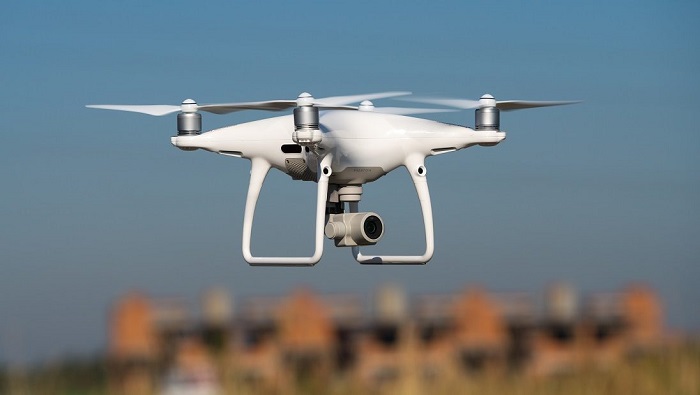
Unmanned aerial vehicles (UAVs), or drones, are already widely used in various real-world settings, including the film industry, the military, and the transport sector. In the future, they could also be used to assist human agents during search & rescue missions, monitor remote or inaccessible environments, and deliver packages.
Most drones on the market today have a similar structure, comprised of the main body and four or more rotating propellers. Some engineers, however, have been developing new drones with alternative designs inspired by birds or other flying creatures.




Arion Pons and Fehmi Cirak, two researchers at the University of Cambridge and the Hebrew University of Jerusalem, have recently introduced a new approach that could enable supermaneuvrability in drones that can adapt their wing configuration. Their approach draws inspiration from the biological dynamics that allow birds, bats, and other flying living organisms to fly in different and elaborate ways.
At the time looking at the ways to make existing unmanned aerial vehicles (UAVs, or drones) more maneuverable. Improvements in maneuverability could lead to better performance in combat drones controlled by artificial intelligence; or more effective missile technology.”
Before they started working on their approach, Pons and Cirak closely studied biological dynamics that allow birds, bats, and other flying creatures to attain extraordinary in-flight maneuverability through complex wing motion. The key objective of their paper was to artificially replicate the wing motion of these animals to radically enhance the maneuverability of UAVs. The recent study also drew inspiration from previous studies in the field of aerospace engineering, which were aimed at developing new technologies to make UAVs more maneuverable.
“By looking at the kinds of complex wing control used by birds, bats, and other flying creatures, we could get an idea of the extreme maneuvering effects of different kinds of wing control,” Pons said. “Simulating these effects on a unique computer model of a maneuvering UAV, we can refine this understanding, and build up a library of what kinds of wing control generate what kinds of effects.”
Pons and Cirak selected specific extreme flight maneuvers, or supermaneuvers, that they wanted their UAV to perform. Using the information in the library they compiled, they could then determine the wing control required to successfully perform these supermaneuvers using UAVs.
“The result is a concrete strategy for achieving different forms of extreme maneuver in a bio-inspired UAV,” Pons said. “Our approach can boost the maneuverability of a relatively mundane UAV to that of a high-performance fighter aircraft, using particular forms of bio-inspired wing morphing control. More specifically, we can recreate forms of supermaneuverability: fantastical maneuvers like tilting the aircraft to a backward-facing direction (the ‘cobra maneuver’), or making it land perfectly on a vertical wall.”
The researchers evaluated the effectiveness of the approach for attaining two main supermaneuvers, known as the Pugachev cobra and ballistic transition maneuvers, using a state-of-the-art flight simulator. These maneuvers had previously only been replicated in UAVs using high-performance and expensive fighter aircraft, yet Pons and Cirak simulated them in far less powerful wing-morphing UAVs.
In the future, their work could pave the way toward the development of highly maneuverable UAVs capable of advanced air-to-air combat, landing on rough or uneven surfaces, and shooting missiles or loitering munitions. In addition, the approach devised by the researchers could be used to study the biological flight dynamics of different animal species.
“In my current position at the Hebrew University of Jerusalem, in Israel, I’m developing bio-inspired drones in collaboration with RAFAEL Advanced Defence Systems,” Pons added. “I hope to develop these bio-inspired drones further and evaluate them for industrial applications. Maybe you’ll see a bio-inspired drone around someday!”

