
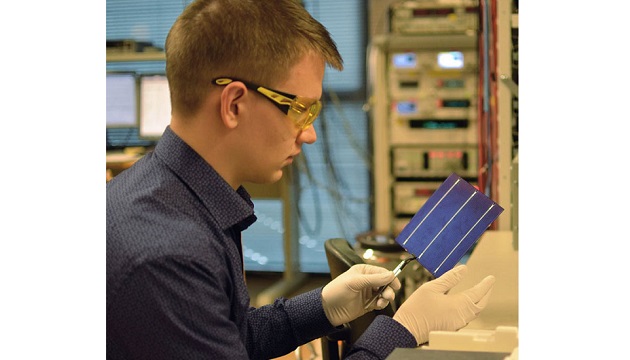
One approach to improving solar cell efficiency is to shift to nanostructured silicon (black-Si, or b-Si), which has been shown to decrease reflective losses in multicrystalline silicon (mc-Si) wafers and prevent cell power conversion efficiency degradation. Researchers at Michigan Technological University analyzed the economic potential for industrial application of dry-etched b-Si. They found that the increase in the overall cell processing costs resulting from the addition of steps for the etching of the b-Si surface would be overcome by the multiple benefits generated by the nanostructuring process.
Researchers already knew that nanotexturing silicon with dry etching makes b-Si more efficient at capturing light than standard etching treatments. “The dry-etching process takes a normally flat silicon surface and etches it into a forest of nanoscale needles. Those needles grab the light and don’t let it get away,” said professor Joshua Pearce.




Normally such a big surface area with many surface defects would hinder electrical performance, but researchers at Aalto University found that when the silicon is also treated with an appropriate atomic layer deposition (ALD) coating, the effects of surface defects are mitigated.
The researchers found that, while the cost of producing b-SI passivated emitter rear cells (PERCs) was approximately 15 to 25 percent higher than production costs for conventional cells, the efficiency gains and the ability to go from monocrystalline silicon (mono-Si) to less the expensive mc-Si outweighted those costs. Overall, they found that the dry etching/ALD approach reduced the cost per unit of solar power by 10.8 percent.
“Improving cost per unit power at the cell level can have massive effects downstream,” said Pearce. “This study points to where the future is going to go in PV manufacturing and what countries might want to do to give themselves a competitive advantage.”
Pearce said that while the production process can be optimized further, the next step would be for policy makers to use the data from the study at a policy level to invest in the equipment that will be needed to manufacture dry-etched PV cells.

