
Meaning of an eAxle
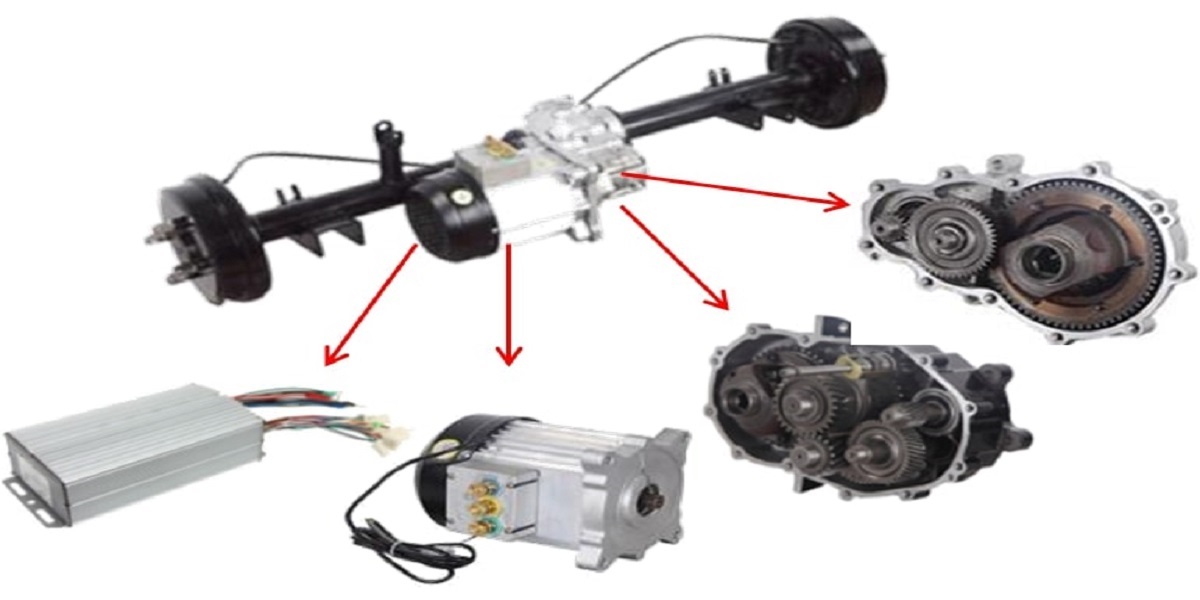
The world ‘eAxle’ stands for electric axle. It is a unit that integrates into the axle structure of a vehicle.




Difference between an eAxle and a mechanical axle
What differentiates an electric axle from a mechanical axle is the source of energy used to propel a vehicle.
A mechanical axle drives a vehicle by transferring energy generated by an engine, using petroleum as a fuel, to the wheels of the vehicle.
On the other hand, an eAxle drives a vehicle by transferring electrical energy to the wheels of the vehicle. The source of this electrical energy is the electrical energy generated by an electric motor, which is one of the three components of an electric axle.
Position of an axle in a vehicle
An axle is situated between the wheels of a vehicle. Usually, an axle is situated between the two wheels of a vehicle. Hence, a four-wheeler vehicle has two axles. They are as follows:
One, at the front of the vehicle. It is situated between the front two wheels.
And, second, at the rear of the vehicle. It is situated between the rear two wheels.
However, the vehicles that have more than four-wheels have correspondingly more axles.
Functions performed by an axle in a vehicle
An axle performs three functions in a vehicle. They are as follows:
First, it puts up, that is, balances, the weight of the vehicle.
Second, converting the power generated by either engine or electric battery into torque. In the case of a mechanical axle, power is generated by a mechanical engine that uses petroleum fuel. On the other hand, in the case of an eAxle, it is generated by an electric battery. It is then converted into torque by the electric motor.
Third, torque transmission. In the case of both mechanical axle and eAxle, the generated torque, that is, rotational force, is transmitted or delivered to the wheels. This aids in their motion and rotation in the desired direction.
How an eAxle performs its functions?
An eAxle performs its functions by means of its three components. They are as follows:
First, an inverter. It controls the flow of electricity into the electric motor depending upon the operational requirement of the motor.
Second, an electric motor. It converts the energy generated through an electric battery or a fuel cell into torque.
And, third, a gearbox. It amplifies the torque that the electric motor produces.
Working principle of an eAxle
An eAxle works in three stages. They are as follows:
First, conversion of the electrical energy derived from the battery into mechanical energy by the electric motor. This mechanical energy is then converted into torque. The power supply to the electric motor is changed by the inverter based on the changes over the accelerator.
Second, transmission of the generated torque.
Third, distribution of the torque to the wheels of the vehicle. This aids in the movement and rotation of the vehicle.
Benefits of using an eAxle
There are numerous benefits of using an eAxle. Few of them are as follows:
First, an eAxle propels a vehicle using electric energy. Hence, it completely eliminates carbon emission. Resultantly, it aids in reducing emission of green house gases. When used over a longer duration, it will help achieve carbon emission reduction commitments under the legally binding United Nations Climate Change Conference (COP21), also called the Paris Conference.
Second, it integrates three components into one structure. Thus, it makes an axle lighter, smaller and compact. This leads to space-saving and easier integration in a vehicle’s powertrain. Besides, it leads to lower energy consumption in propelling a vehicle. Therefore, it will increase the efficiency of energy consumption.
Third, as an eAxle is undergoing miniaturing due to integration of many components into one, its large-scale cost of production of low. Hence, it is cost-effective.
Application of eAxle in different types of automobiles
An eAxle is mainly used in the following types of automobiles:
First, battery electric vehicles.
Second, fuel cell electric vehicles.
Third, hybrid electric vehicles.
And, fourth, plug-in hybrid electric vehicles.
An axle is one of the components of a vehicle’s powertrain
An eAxle is one of the five components of a vehicle’s powertrain.
Components of a vehicle’s powertrain
A vehicle’s powertrain consists of five components. They are as follows:
First, engine.
Second, transmission.
Third, driveshaft.
Fourth, axle.
And, fifth, differential.
Functions of a vehicle’s powertrain
A vehicle’s powertrain propels a vehicle. Propelling a vehicle has two ingredients. They are as follows:
One, thrusting a vehicle into motion- both forward and backward.
And, two, aiding in the movement of the vehicle in the right direction.
First company in the world to integrate eAxle in its automobile
Toyota was the first manufacturer in the world to introduce eAxle. It did so in its Crown Majesta EV model in 1993. It an eAxle which is now categorised as the first generation eAxle.
Generations of eAxles developed so far
At present, new technological advancements are leading to the development of what is referred to as the third generation eAxle. Hence, till date, three generations of eAxles have been developed.

