
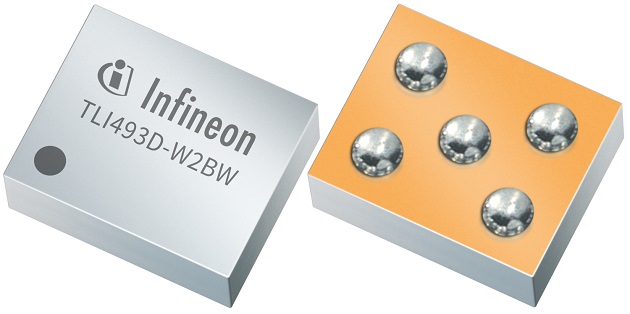
Infineon Technologies AG (FSE: IFX / OTCQX: IFNNY) will expand its XENSIV™ 3D magnetic sensor family TLx493D. At its in-house digital trade show “Virtual Sensor Experience”, the chipmaker will present a new device for industrial and consumer applications: the TLI493D-W2BW. It uses the latest 3D Hall generation from Infineon and is housed in an extremely small wafer-level package. With an 87 percent smaller footprint and 46 percent less height than previous comparable products, the sensor opens up new design options.
Due to the small WLB-5 package (1.13 mm x 0.93 mm x 0.59 mm) and its low current consumption of 7 nA in power-down mode, the new magnetic sensor is also suitable for use in applications that previously used resistor-based or optical solutions. Magnetic sensors offer numerous advantages here, such as their high accuracy or robustness against dust and moisture. In addition, magnetic sensors are easier to assemble and offer more design options.




In particular, the low height of the TLI493D-W2BW is helpful in extremely space-critical applications such as BLDC commutation in micromotors or control elements such as joysticks or game consoles. It enables designs with double-sided PCBs or positioning of the sensor between two PCBs. This allows optimal use of the available space; for example, additional components can be placed above the sensor.
Technical features
The new sensor has an integrated wake-up function. It is available in four variants with preconfigured standard addresses. A higher resolution (typ. 32.5 to 130 µT/LSB12) compared to the previous generation extends the range of applications. XY angle measurement is also supported.
The update rate is up to 5.7 kHz (8.4 kHz for XY), while the resolution in low-power modes can be adjusted in eight steps between 0.05 and 770 Hz. Power consumption in power-down mode is specified at 7 nA. The supply current is 3.4 mA. The sensor has an I2C interface and a dedicated interrupt pin.
Availability
Samples of the new XENSIV 3D sensor TLI493D-W2BW are already available. Series production will start in August 2020.
Further information, visit www.infineon.com

