

As many organizations want to support mobile, team-oriented and nonroutine ways of work, an increasing number of them are looking for assistance in adopting digital workplace technology. A Gartner, Inc. survey concluded that only 7 percent to 18 percent of organizations possess the digital dexterity to adopt new ways of work (NWOW) solutions, such as virtual collaboration and mobile work.
An organization with high digital dexterity has employees who have the cognitive ability and social practice to leverage and manipulate media, information, and technology in unique and highly innovative ways.




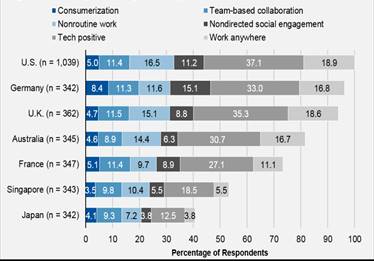
By country, organizations exhibiting the highest digital dexterity were those in the U.S. (18.2 percent of respondents), followed by those in Germany (17.6 percent) and then the U.K. (17.1 percent). “Solutions targeting new ways of work are tapping into a high-growth area, but finding the right organizations ready to exploit these technologies is challenging,” said Craig Roth, research vice president at Gartner.
In parallel, the survey found that workers in the U.S., Germany, and U.K. have, on average, higher digital dexterity than those in France, Singapore and Japan (see Figure 1).
Workers in the top three countries were much more open to working from anywhere, in a non-office fashion. They had a desire to use consumer (or consumer-like) software and websites at work. Some of the difference in workers’ digital dexterity is driven by cultural factors, as shown by large differences between countries. For example, population density impacts the ability to work outside the office, and countries with more adherence to organizational hierarchy had decreased affinity for social media tools that drive social engagement.
Older Workers Are Second-Most Likely Adopters of NWOW
As expected, the youngest workers are the most inclined of all age groups to adopt digital-workplace-driven products and services (see Figure 2). They have a positive view of tech in the workplace and a strong affinity for working in nonoffice environments. Nevertheless, they reported the lowest levels of agreement with the statement that work is best accomplished in teams.
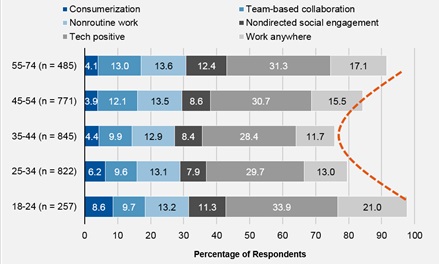
The survey also showed that the oldest workers are the second most likely adopters of NWOW. Those aged 55 to 74 have the highest opinion of teamwork, have progressed to a position where there is little routine work, and have the most favorable view of all age groups of internal social networking technology.
Workers aged 35 to 44 were at the low point of the adoption dip, potentially feeling fatigued with the routines of life as middle age approaches. They were most likely to report that their jobs are routine, have the dimmest view of how technology can help their work and are the least interested in mobile work.
Larger organizations on average had higher digital dexterity than smaller ones. “Embracing dynamic work styles, devices, work locations and team structures can transform a business and its relationship to its staff. But digital dexterity doesn’t come cheap,” said Mr. Roth. “It takes investment in workplace design, mobile devices, and software, and larger organizations find it easier to make this investment.”

