
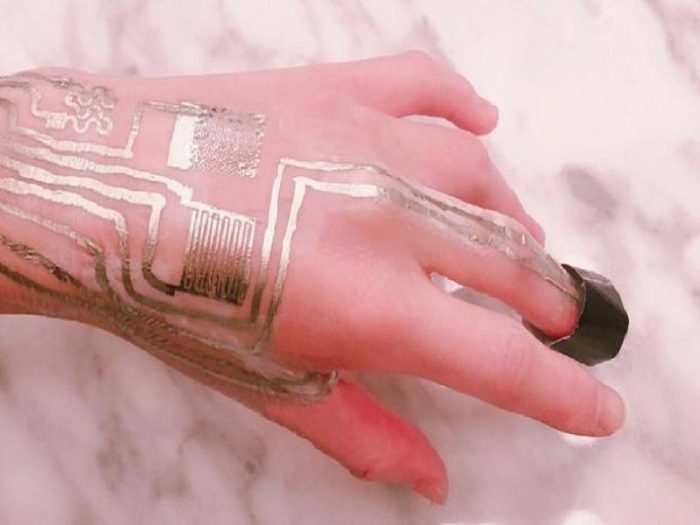
In industry, people work with robots. While this can accelerate productivity, it does come with health and safety risks. As a result, some robots must be kept separate from human workers. This comes at a heavy financial cost and negatively affects human-robot interactions. If there were sensors on robots to detect a person, then these issues could be solved, but current sensors rely on impractical, rigid, and thick electronics. TU/e researchers have designed a way to make flexible, thin, and accurate sensor electronics that outperform many current sensors.
Our world is filled with robots. From robot vacuum cleaners to robot dog walkers, we have incorporated robots into many aspects of daily life. In industry, robots have helped to automate many tasks, and in the process, they provide both an accuracy and speed that are beyond human capabilities.




However, that doesn’t mean that humans and robots do not work closely together in the industry. “Many industrial operations require close human-robot interactions,” says researcher Marco Fattori from the department of Electrical Engineering and the TU/e startup MicroAlign. “This means that the robots need accurate proximity sensors to check if someone gets too close to the robot. Once someone is detected, the robot shuts down to prevent any injuries to the person.”
Many of the current sensors are based on silicon components, but these are rigid and thick, which makes it difficult and costly to place them on the surface of the robot.
New flexible printed electronics
“The alternative is flexible printed electronics, but this kind of electronics has lower capabilities compared to silicon chips,” notes Eugenio Cantatore from the department of Electrical Engineering. “Flexible electronics are slow and noisy, which negatively affects their accuracy. But unlike silicon sensors, the flexible ones can be placed over large surface areas, are cheap to make, and can be produced in large quantities.”
So, to solve the issue of making accurate flexible electronics, Fattori and Cantatore, in collaboration with researchers based in France, Austria, and the U.K. developed new flexible electronics made by printing organic materials based on polymers. The printing approach allows for the placement of front-end electronics (the first electronics layer after the sensor) in each pixel of the device.
“In effect, we printed electronics on a plastic or foil sheet, then we placed the sensors on another foil. After that we laminated the two foils together, leading to an ultra-flexible and thin sensor,” says Fattori. “This combination enhances signal quality in comparison to previous sensors.”
The robot arm
For this study, the researchers placed long-wavelength infrared organic pyroelectric sensors (heat sensors) in the flexible foil. “We created a large flexible sheet filled with heat sensors that can be used to cover a structure, such as a robotic arm for example,” says Cantatare.
And that’s exactly what the researchers did. They wrapped a flexible sheet of heat sensors around a robotic arm to simulate an industrial work environment where a human works close to a robot.
“The flexible sensor acts as a sort of ‘artificial skin’ for the robot. The heat sensors allow the robot to detect the presence of a moveable heat source, such as a person, from a distance of up to 0.4 meters away,” notes Fattori. “What’s more, the sensors can also detect a human hand approaching from different directions and not just from directly in front of it.”
Great promise
Besides applications in the industry with robots, the researchers note that the ability to produce affordable flexible sensors could be useful in numerous other fields, such as healthcare.
For example, they could be used to map pressure distributions on a mattress, and thus help patients avoid bedsores. In addition, they could be used to check if elderly people experience falls in their homes or in care homes by embedding sensors in the floors. These kinds of sensors could even be adapted to monitor the integrity of airplane wings.
This research is part of a complex European collaborative project called ATLASS. “After years of work, we have demonstrated for the first time with a practical, useful example, the great promise of low-cost printed sensing surfaces that include electronics,” says Cantatore. “We are excited to use these results to initiate new research endeavors at TU/e.”

