
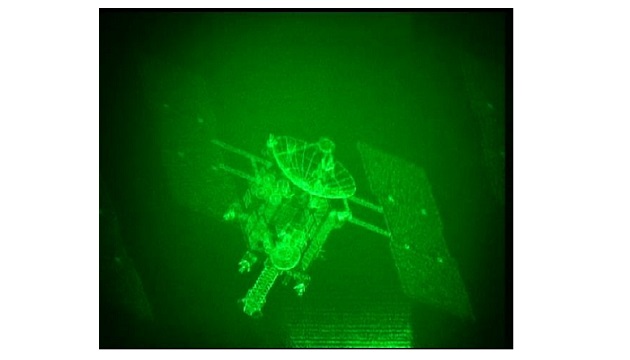
Researchers at Chiba University are developing a computer that can project high-quality 3D electroholography as a video, a project that they began about 25 years ago. The team, led by professor Tomoyoshi Ito, has been working to increase the speed of the holographic projections by developing new high-performance hardware.
The original computation system for electroholography, named HOlographic ReconstructioN (HORN), was developed in 1993. The latest version of HORN, HORN-8, was developed using field programmable gate array (FPGA) technology.



Initially, a circuit for amplitude-type electroholography was implemented in HORN-8. However, to realize a photorealistic 3D image with the HORN system, the researchers needed to implement a phase-type computer-generated hologram (CGH) in HORN-8. A new version of HORN-8 and its cluster system was developed.
A calculation method for adjusting the phase of light was also implemented in the latest phase-type HORN-8. Eight chips were mounted on the FPGA board to avoid bottlenecks that, along with the calculation method, could affect the processing speed. With this approach, HORN-8 was able to increase the computing speed in proportion to the number of chips, which allowed it to project video holography more clearly.
Using the phase-type HORN-8, the researchers demonstrated the ability to project holography information as a 3D video with high-quality images. The HORN-8 was able to reconstruct 3D videos composed of tens of thousands of point-light sources (PLSs) in video rate. It achieved a real-time reconstruction of a 3D movie with point clouds composed of 32,000 points. The team believes that this rate could be realized in interactive systems such as TVs and telephones.
The performance of HORN-8 is approximately the same as the latest GPU; however, because the FPGAs mounted on the HORN-8 are not the newest type, its performance could be significantly improved when the latest model FPGAs are used, the researchers said.
To make a 3D object from 2D data, several factors must be considered, including the binocular parallax, motion parallax, convergence angle, and focus adjustment. Currently, most 3D TVs use the binocular parallax for the stereoscopy function.
Takashi Nishitsuji, a former student of Ito’s lab and now assistant professor at Tokyo Metropolitan University, said, “HORN-8 is the fruit of many people’s wisdom, skills, and efforts. We want to continue the research of HORN and try other methods from various perspectives for its practical application.”

