
Courtesy: Manage XR
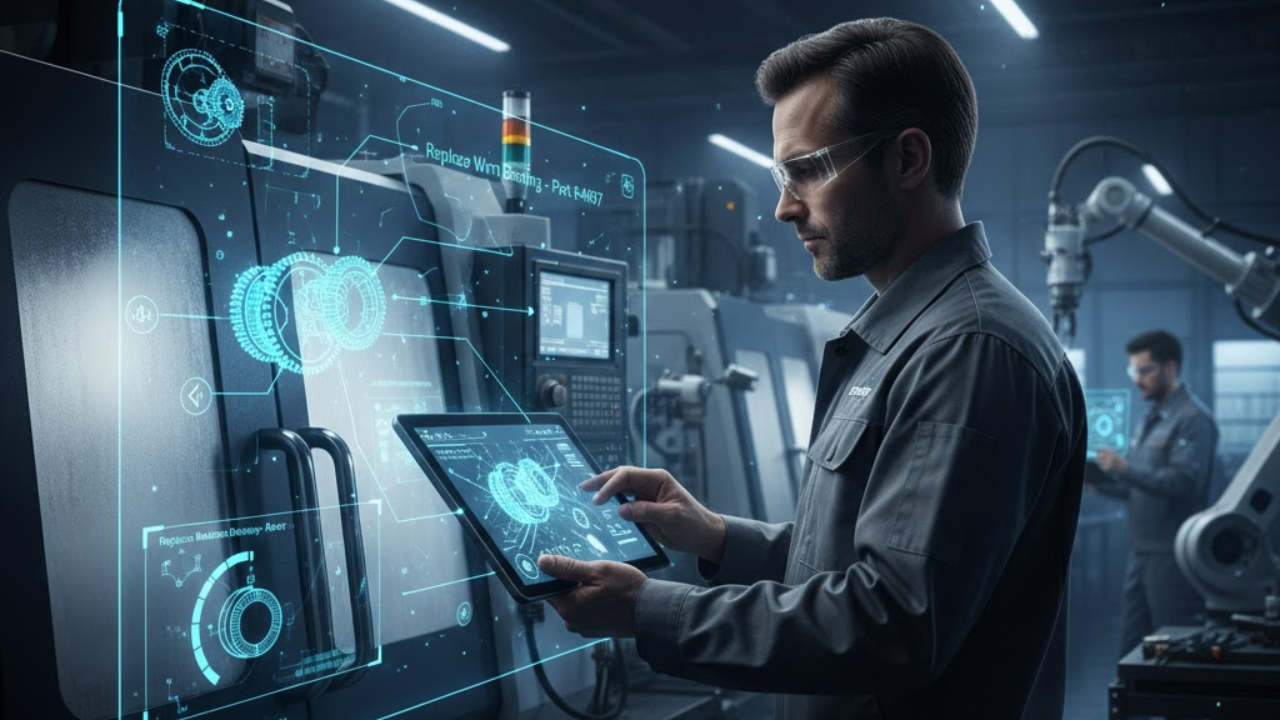
Just before 7 a.m., a worker clocks in at a bustling manufacturing facility and slips on a pair of AR glasses. Today’s assignment: a recently launched assembly line with new equipment.




As they approach their station, the AR interface overlays a 3D schematic of the equipment they’ll be working on. Real-time instructions walk them through the assembly sequence with visual cues that highlight where each part goes. If they miss a step, the system prompts them to go back and complete it, ensuring no detail is overlooked.
Mid-shift, they encounter a machine part they’ve never handled before. A quick tap on the glasses launches a remote support session. Instantly, a subject-matter expert joins the view, sees exactly what the worker sees, and draws helpful annotations directly into the field of vision.
During the end-of-day quality check, the glasses display an inspection checklist, enhanced with AI object recognition to automatically detect missing or misaligned components. Once the inspection is complete, the worker returns their glasses to their charging port and wraps up their AR-powered day at the factory.
In 2025 and beyond, AR is poised to transform production cycles as we know it, and manufacturers have the unique opportunity to seize the benefits.
A Critical Manufacturing Labour Shortage
Manufacturers today are struggling to fill manufacturing jobs. As of May 2025, the US Bureau of Labour Statistics reports nearly 500,000 manufacturing jobs remain unfilled. The manufacturing sector has tried to combat the shortage in several ways, including raising wages. However, the problem that manufacturers face runs deeper than compensation.
According to Carolyn Lee, the president and executive director of the Manufacturing Institute, “the challenge is that there is no one walking around on the street with these skills, and it takes one to two years to teach those skills and another one to two years to contextualise those skills to the specific plant environment.” To close the labour gap, manufacturers can educate workers to operate complex machinery and find ways to make that machinery easier to use.
Augmented reality (AR) is uniquely positioned to tackle this challenge: accelerating workforce readiness, increasing productivity, and providing real-time operational support.
The Future of Manufacturing
AR is proving itself to be an invaluable tool across the manufacturing lifecycle, from product development and design to operations and optimisation.
Here’s how AR is making an impact today.
Remote Assistance and Maintenance
Field service technicians are frequently sent to job sites only to discover unexpected challenges that require knowledge they may not have. This can result in costly delays and repeated visits. Augmented reality remote assistance enables technicians to receive support from off-site experts who can see what they see and guide them through tasks in real-time. AR makes this possible with video streams and contextual instructions.
Alghanim Industries Xerox Service (AIXS), a key provider of on-site support for Xerox printing machines, aimed to reduce service costs by empowering entry-level technicians with expert guidance. To accomplish this, AIXS adopted an AR solution that enables remote subject matter experts to deliver real-time, visual support to field technicians. The platform has significantly improved service accuracy and internal knowledge transfer. Following implementation, 90% of technicians reported positive experiences with guided AR instructions, and 88% said they gained new skills.
Assembly and Quality Assurance
Day-to-day assembly requires constant quality checks to ensure consistent production standards. It’s a tedious and often manual process. To simplify this, AR-powered overlays provide real-time visual guidance during complex assembly tasks, ensuring every component is placed accurately. Workers receive feedback instantly if something is out of alignment, allowing them to correct mistakes on the spot.
For industries where detail is pivotal, the result is greater consistency, fewer defects, and improved throughput.
Nascote Industries, a division of automotive giant Magna International, uses augmented reality to improve both quality control and employee training on the manufacturing floor. Nascote has replaced paper-based training and inspection methods with AR-enhanced instructions for complex assembly tasks and quality checks. In particular, AR has helped identify subtle issues, such as soft electrical connections, that traditional inspections might miss. As a result, the company has improved defect detection.
GE Aviation, a key supplier of engines and avionics for aircraft like Boeing and Airbus, has introduced augmented reality (AR) smart glasses to improve its assembly lines. By delivering hands-free, real-time instructions directly into workers’ fields of view, AR eliminates the need to pause tasks or reference printed manuals. No more flipping back and forth between paper checklists and machinery. Initially piloted to support mechanics using torque wrenches, the technology not only improved bolt-tightening but also accelerated task completion by reducing unnecessary movements and distractions. The result is faster assembly and a safer, more efficient work environment.
Factory Planning and Optimisation
AR has also been identified as a key use case in manufacturing, even before production begins. AR enables manufacturers to design and optimise factory layouts before a single piece of equipment is installed. The physical configuration of a manufacturing facility, such as where machines, tools, materials, and personnel are positioned, has a direct impact on workflow efficiency. Poor layout decisions can lead to bottlenecks and wasted motion, which undermine productivity and profitability.
With virtual reality, manufacturers can create digital twins of their facilities, allowing teams to walk through proposed layouts in a virtual environment. This makes it easy to identify inefficiencies and test alternate configurations. Augmented reality, alternatively, lets stakeholders overlay virtual layouts onto physical spaces to evaluate how new designs will function in the real world.
This proactive approach to factory planning minimises costly rework, shortens the time to full production, and ensures the space is designed with both workflow and human factors in mind.
BASF, the world’s largest chemical company, is using augmented reality to transform factory planning. Through AR glasses, BASF engineers can visualise and manipulate CAD models as holograms directly within existing factory environments. This enables true-to-scale comparisons between virtual plans and physical spaces, helping identify potential design conflicts like misaligned pipelines early in the planning phase. The AR system allows teams to collaboratively review and edit digital models on-site or remotely.
Inventory Management
AR has found a strong foothold within inventory management. With AR-enabled smart glasses or tablets, workers can receive real-time visual instructions, helping them locate items faster, confirm quantities, and reduce human error.
For example, DHL implemented AR smart glasses in several warehouses as part of a pilot program. Workers using the glasses received visual cues on where to find items and how to place them correctly for order fulfilment. The result was a notable increase in productivity and a significant reduction in picking errors.
In another case, Volvo Group, which supports critical transportation and infrastructure operations by delivering spare auto parts to over 3,000 global dealers, turned to augmented reality to enhance speed and accuracy in its distribution centres. At its Sydney Distribution Centre, Volvo implemented an AR inventory solution, equipping warehouse workers with smart glasses that display real-time picking instructions, such as part locations, descriptions, and quantities. This AR-guided system replaced manual, paper-based workflows, resulting in a 25% improvement in picking quality. The hands-free interface reduced errors and accelerated order fulfilment.
Overcoming Challenges
While AR offers unique benefits, manufacturers may encounter some hurdles in scaling these technologies effectively. These include high upfront costs, content development, user adoption, security concerns, and ongoing device management.
- Cost: The initial investment in hardware, software, management, and implementation can be significant. Headsets, custom-built content, and integration with existing systems all contribute to the total cost of ownership. However, companies that begin with focused pilot programs and measure ROI early, such as reductions in training time, error rates, and downtime, often find the long-term gains far outweigh the costs.
- Content: One of the biggest questions companies face is whether to develop custom content or adopt off-the-shelf solutions. Custom content offers precision and relevance but can be expensive and time-consuming to create. Off-the-shelf content is faster to deploy but may lack the specificity required for certain manufacturing tasks. The key is to evaluate which areas of your operations would benefit most from immersive training or visualisation and align content decisions accordingly.
- User Adoption: Even with the right hardware and content, success depends on worker engagement. Adoption can lag if employees find the technology cumbersome or irrelevant. The solution lies in designing intuitive experiences, providing clear onboarding, and demonstrating how the VR and AR program can improve day-to-day tasks. When workers experience real productivity gains and safety improvements, adoption tends to follow.
- Security: AR/VR applications often involve sensitive, proprietary information, whether it’s product designs, manufacturing methods, or facility layouts. Ensuring this data remains secure across all devices and platforms is non-negotiable. Encryption, access controls, and regular software updates are essential for maintaining data integrity and regulatory compliance.
- Device Management: As deployments grow, managing fleets of headsets becomes increasingly complex. Devices must be kept updated, secured, and configured consistently across facilities. This is where solutions like ManageXR come in. ManageXR provides enterprise-grade tools for remotely configuring, updating, and monitoring XR devices at scale. From deploying training modules to pushing software updates or locking down devices for specific use cases, a robust device management platform ensures operational consistency, security, and scalability, without IT overhead.
Conclusion
Manufacturing faces a critical moment. The labour shortage, skill gap, and pressure to remain competitive necessitate a new approach that incorporates technological innovation and workforce transformation.
AR is a powerful tool that directly addresses the industry’s most pressing challenges. By optimising operations and enabling real-time collaboration, AR can unlock new levels of productivity.
Implementing an AR program at scale for your manufacturing facility is within reach. Talk to our XR experts to learn how you can get started integrating AR into your factory workflows. We’ll guide you through procuring the right hardware, custom content, and management software for your needs.

