
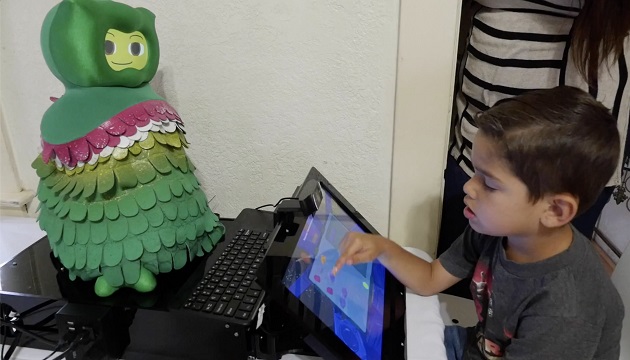
USC researchers developed personalized learning robots for children with autism and studied whether the robots could autonomously gauge the child’s engagement in long-term, in-home therapeutic interventions
Now, researchers at USC’s Department of Computer Science have developed personalized learning robots for children with autism. They also studied whether the robots could estimate a child’s interest in a task using machine learning.



Many children with autism face developmental delays, including communication and behavioural challenges and difficulties with social interaction. This makes learning new skills a major challenge, especially in traditional school environments.
In one of the largest studies of its kind, the researchers placed a socially assistive robot in the homes of 17 children with autism for one month. The robots personalized their instruction and feedback to each child’s unique learning patterns during the interventions.
Robots getting smarter
Robots are limited in their ability to autonomously recognize and respond to behavioural cues, especially in atypical users and real-world environments. This study is the first to model the learning patterns and engagement of children with autism in a long-term, in-home setting.
It’s a bidirectional process and that doesn’t happen with current robotic systems. This study aims to make robots smarter by understanding the child’s behaviour and responding to it in real- time.” The researchers stress the goal is to augment human therapy, not replace it.
Enhancing the learning experience
The algorithms monitored the child’s performance on the math games. For instance, if a child answered correctly, the robot would say something like, “Good job!” If they got a question wrong, it might give them some helpful tips to solve the problem, and adjust the difficulty and feedback in future games. The goal was to maximize difficulty, while also not pushing the learner to make too many mistakes.
If you have no idea what the child’s ability level is, you just throw a bunch of varying problems at them and it’s not good for their engagement or learning. But if the robot is able to find an appropriate level of difficulty for the problems, then that can really enhance the learning experience.
The ultimate frontier
Autism is the ultimate frontier for robotic personalization, because as anyone who knows about autism will tell every individual has a constellation of symptoms and different severities of each symptom.
This presents a particular challenge for machine learning, which usually relies on spotting consistent patterns in huge amounts of similar data. That’s why personalization is so important. The researchers tackled this problem in their analysis of the children’s engagement after the intervention. Computer models of engagement were developed by combining many types of data, including eye gaze and head pose, audio pitch and frequency, and performance on the task.
Improving human-robot interaction
Assessments were conducted before and after the month-long interventions. While the researchers expected to see some improvements in participants, the results surpassed their expectations. At the end of the month’s intervention, 100% of the participants demonstrated improved math skills, while 92% also improved in social skills.
In post-experiment analyses, the researchers were also able to glean some other interesting information from the data that could give us a peek into the recipe for ideal child-robot interactions.
The study observed higher engagement for all participants shortly after the robot had spoken. Specifically, participants were engaged about 70% of the time when the robot had spoken in the previous minute, but less than 50% of the time when the robot had not spoken for more than a minute.
The study observed caregivers only had to intervene when a child lost interest for a longer period of time. In contrast, participants usually re-engaged by themselves after shorter periods of disinterest. This suggests robotic systems should focus on counteracting longer periods of disengagement.

