
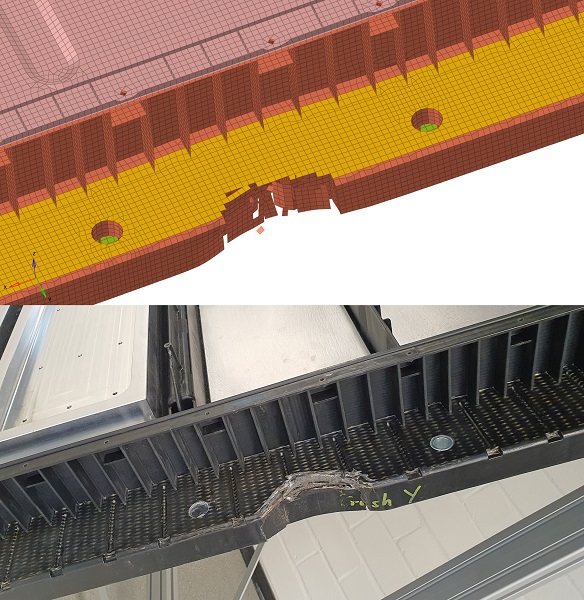
Technical plastics such as polyamide 6 offer numerous benefits for the design of battery enclosures for electric vehicles – in terms of sustainability, manufacturing costs, weight savings, and economical functional integration, for example. However, there were previously lingering doubts as to whether these large and complex components are also able to meet the very demanding requirements in relation to mechanical strength and
flame-retardant properties. Kautex Textron and LANXESS have now carried out a comprehensive examination of precisely this using a jointly developed technology demonstrator made from polyamide 6.
LANXESS was responsible for the material development and Kautex Textron for the engineering, design, and manufacturing process of the demonstrator.
“The near-series demonstrator passes all mechanical and thermal tests that are relevant for such enclosures. In addition, solutions for the thermal management and leak tightness of the enclosure, for example, have been developed. This all has proven the technical feasibility of these safety components, which are complex and subject to high levels of stress,” explains Dr. Christopher Hoefs, Project Manager e-Powertrain at LANXESS. At the moment, an enclosure prototype is being road-tested in a test vehicle to verify its suitability for daily use. “We are currently jointly tackling the first series- production development projects with automotive manufacturers in order to implement the new technology in series production” explains Felix Haas, Director of Product Development at Kautex Textron.




Smaller carbon footprint
“Calculations revealed that the carbon footprint of the plastic enclosure is over 40 percent smaller compared to an aluminum design. The lower energy use in the production of polyamide 6 compared with metal as well as other factors – such as the omission of time-consuming cathodic dip painting to prevent corrosion where steel is used – help to minimize the carbon footprint,” says Hoefs. The thermoplastic component design also makes recycling the enclosure easier compared with thermoset materials such as sheet molding compounds (SMC), for example.
Highly durable, and resistant to external fire sources The tests on the technology demonstrator were carried out in accordance with internationally recognized standards for battery-powered electric vehicles such as ECE R100 from the Economic Commission for Europe or the Chinese standard GB 38031. The large-format all-plastic enclosure, which measures around 1,400 millimeters in both length and width demonstrated its performance in all relevant tests. For example, it meets the requirements of the mechanical shock test, which is used to examine the component’s behavior in the event of severe shocks, and of the crush test, which the developers use to examine the resistance of the battery enclosure in the event of slow deformation. The results of the drop and vibration tests were also positive, as were those of the bottom impact test. This test examines the stability of the batteries, which are mostly accommodated in the vehicle floor, in the event of ground contact with the vehicle structure or of impacts from sizeable stones. “All test
results corroborate the previous simulations and calculations. A critical failure of the plastic enclosure would not have occurred in any of the load cases,” explains Haas. The demonstrator also proved its resistance to external sources of fire underneath the vehicle in
accordance with ECE R100 (external fire).
The demonstrator was developed based on the aluminum battery housing of a mid-size electric vehicle designed for mass production. It is manufactured in a single-stage compression molding process with a molding compound based on the polyamide 6 compound Durethan B24CMH2.0 from LANXESS and does not require any further rework. Crash-relevant areas are specially reinforced with locally placed blanks made from the continuous fiber-reinforced, polyamide 6-based composite Tepex Dynalite 102- RGUD600. Compared with an aluminum design, there is a weight saving of around 10 percent, which is advantageous for the range and therefore the carbon footprint of the vehicle. The integration of functions – such as the fasteners, reinforcing ribs, and components for thermal management – reduces the number of individual components significantly compared with the metal design, which simplifies assembly and logistical effort and reduces manufacturing costs.
You can find more detailed information about LANXESS products and
technologies for the field of new mobility and battery innovations from
Kautex Textron at https://lanxess.com/en/Products-and- Solutions/Focus-Topics/LANXESS-e-Mobility and http://www.kautex.com/en/mobility/battery-systems.

