
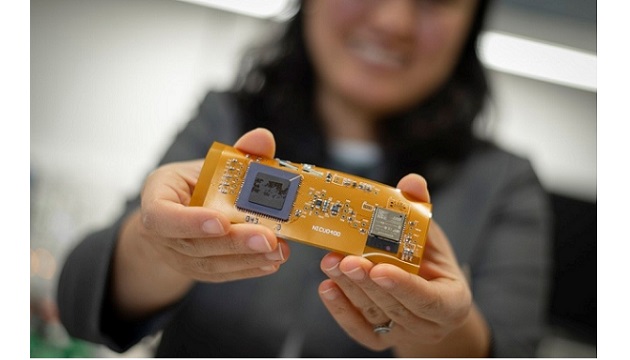
At Worcester Polytechnic Institute (WPI), researchers have been creating a sensor that measures just the size of a Band-Aid. The sensor will have the ability to measure an infant’s blood oxygen levels, which is a crucial indication of lung effectiveness and whether the tissue of the infant is receiving a sufficient supply of oxygen.
Professor Ulkuhan Guler shows off an early prototype of the miniaturized, wearable device that will one day monitor infants’ blood oxygen levels.




In contrast to existing systems used in hospitals, the new miniaturized wearable device will be stretchable and flexible, inexpensive, wireless, and mobile—potentially enabling the child to leave the hospital and be monitored remotely.
The project is being led by Ulkuhan Guler, assistant professor of electrical and computer engineering and director of WPI’s Integrated Circuits and Systems Lab. The aim is to allow sick, hospitalized infants to be untethered from wired sensors, which would enable them to be more frequently and easily examined, held, and even permitted to leave the hospital.
Guler and her colleagues have created a miniature oxygen monitor for infants, which quantifies blood gases that diffuse through the skin, and wirelessly reports the data.
In general, transcutaneous measurement of oxygen molecule levels is performed by using a system that includes a roughly 5-pound monitor connected to an electrical outlet, and sensors that are often wired to the monitor.
The healthcare device developed by Guler will employ wireless power transfer. Moreover, it will be wirelessly linked to the Internet, enabling an alarm on a monitor in a doctor’s office or smartphone app to notify family members and medical personnel if the infant’s oxygen level starts to drop.
The device has been engineered to measure PO2 (i.e. the partial pressure of oxygen), which specifies the amount of oxygen dissolved in the blood. This measure is a highly precise indicator of respiratory health when compared to a simple oxygen saturation measurement, which can be easily carried with a pulse oximetry device carefully clamped on a finger.
Moreover, the measurement of PO2 level through a noninvasive device affixed to the skin is as accurate as a blood test. The wearable baby oxygen monitor can also be used for adults, specifically patients suffering from severe asthma and elderly people with chronic obstructive pulmonary disease (COPD).
COPD is a progressive, incurable lung disease, which is the third leading cause of death in the United States, as per the reports of the Centers for Disease Control and Prevention. In a subsequent phase of the study, Guler will adapt the wearable device for adults, and also develop a related smartphone app.
Guler has been working together with Pratap Rao, associate professor of mechanical engineering at WPI, and Lawrence Rhein, MD, chair of the department of pediatrics and an associate professor at the University of Massachusetts Medical School.
Ian Costanzo and Devdip Sen, both graduate students in electrical and computer engineering at WPI, are also collaborating with Guler to develop a chip that will ultimately serve as the heart of the wearable device.
Rhein has been giving inputs to Guler on what is required in a hospital and home setting.
The chip has been designed to operate within the wearable oxygen monitor, activate the optical sensors, capture analog signals from the sensor, handle power management, and contain the needed circuitry. Guler and colleagues have customized the individual circuits—for example, driver circuits and signal capturing circuits—for optical-based read-out circuits.
The next step of the research project would involve adding more circuitries to the chip to digitize the analog signals, convey the captured and digitized data, and produce power from a wireless link. If this is achieved, then it would be a complete system on the chip.
As part of interdepartmental collaboration, Guler and Rao have been developing miniaturized flexible and thin sensors for wearable healthcare devices, which will be secure and comfortable on the infants when they move.
The researchers have authored four papers (two more papers are being prepared about their study), separately focusing on miniaturizing devices, developing the prototype, oxygen measurement methods, and constructing the chip.

