

Electronics manufacturer E.D.&A. uses neural networks to make its electronic controllers smarter. Neural networks (including binary ones) are very good at recognising patterns and are therefore an excellent solution for dealing with problems differently.
Prediction vs actual behaviour



Electronics manufacturer E.D.&A. investigated how well a neural network can be trained. Take, for example, hob ventilation, in which the electronic controller is operated using capacitive touch sensors. These sensors are located under a thick sheet of glass and in addition there is moisture, dirt and interference from the induction hob itself.
E.D.&A. trained the neural network to recognise the right signal (e.g. switch on) among all this ‘noise’. The large amount of training examples required was obtained using an artificial finger, which operated the sensor using compressed air, meaning the collection of data could be automated. The binary variant of neural networks was also further evaluated by E.D.&A. for use with its electronic controllers (microcontrollers). Neural networks (including binary ones) are very good at recognising patterns and are therefore an excellent solution for dealing with problems differently.
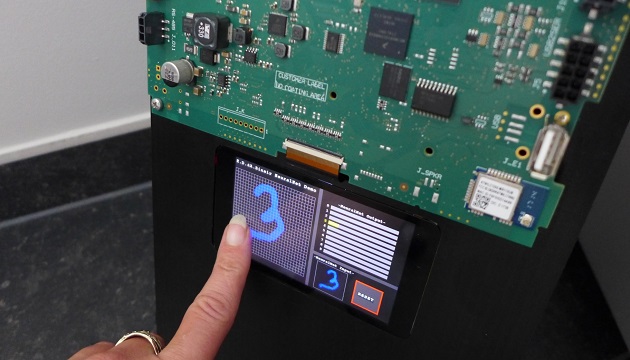
To illustrate this, E.D.&A. implemented a demo of its own embedded AI (Artificial Intelligence) framework for machine and device manufacturers. You draw a number from 0 to 9 on a touchscreen and in the background it is passed on to a binary neural network. This binary neural network works out the number you mean and shows the result.
What is a “neural network” and how does it work?
An artificial neural network is an imitation of our brain (biological neural network), in both construction and operation. It is used, among other things, for photograph recognition.
For example, we can make a system “smart” so that it can determine whether or not a given photo is of a dog. You develop a neural network by training it with a long series of examples. The underlying technology is a long, simple calculation that is fine-tuned on the basis of examples until it gives a correct result for all input values. Neural networks are really good at recognising patterns, and after training even new photos can be properly assessed.

