
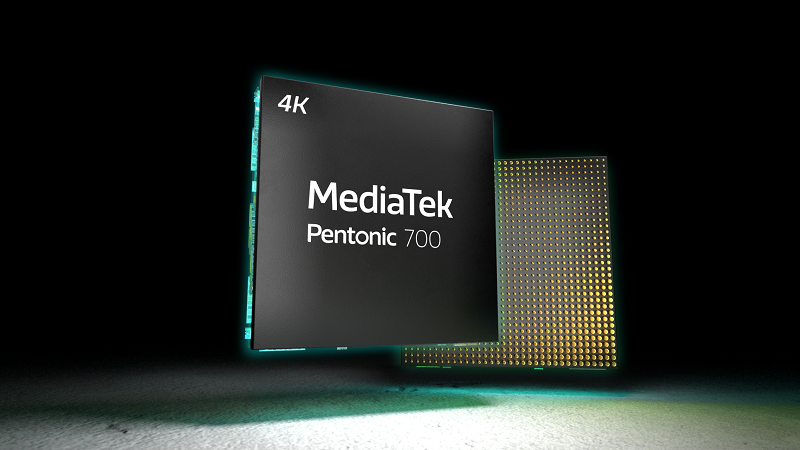
MediaTek announced the Pentonic 700, a smart TV system-on-chip (SoC) with a powerful AI processing engine for premium 120Hz 4K TVs. With AI-powered picture quality enhancements, support for Dolby Vision IQ with Precision Detail integrated 4K120 MEMC and TCON, and gaming optimizations, the Pentonic 700 lets global TV brands elevate the all-around viewing experience for consumers.
“MediaTek’s Pentonic series brings more intelligence to smart TVs with a host of AI-powered picture quality enhancements,” said Alex Chen, General Manager of the TV Business Unit at MediaTek. “Smart TV brands can count on Pentonic 700 to deliver incredible experiences whether consumers are watching videos or sports, gaming, or using their TV as a control centre for their other smart devices.”




The Pentonic 700’s integrated AI processing unit (APU) supports MediaTek’s AI-Super Resolution, AI-Picture Quality (AI-PQ) Scene Recognition and AI-PQ Object Recognition technologies for advanced edge smoothing and detail reconstruction. Dolby Vision IQ with Precision Detail further improves picture quality by improving the contrast in bright and dark spots for crisp, sharp imagery.
Smart TVs powered by the Pentonic 700 can display content from different sources on the TV screen with Picture-by-Picture (PBP) and Picture-in-Picture (PIP) support with PQ enhancement. At home, this technology allows users to stream different sporting events at the same time or video chat with friends and family while watching content together. In the office, these capabilities provide more video conferencing options and allow TVs to display different content streams at the same time.
While Pentonic 700 is designed for 120Hz smart TVs, the chipset also supports variable refresh rates (VRR) up to 144Hz to give brands the ability to customize TVs for gaming applications so players can enjoy games without screen tearing and stuttering. Other optimizations for gameplay include HDMI 2.1 Auto Low Latency Mode (ALLM) to minimize display lag and Dolby Atmos’ technology for immersive sound.
The key specs of the MediaTek Pentonic 700 include:
- Resolution support up to 4K at 120Hz and capable of VRR up to 4K at 144Hz for gaming applications.
- Dolby Vision IQ with Precision Detail for improved detail with added texture and depth.
- HDR10+ Adaptive technology to offer optimal viewing experiences based on a room’s lighting conditions.
- MediaTek’s AI-PQ Scene Recognition 2.0 automatically optimize picture quality settings.
- MediaTek’s AI-PQ Object Recognition 2.5 enhances the depth of view by applying different sharpness, contrast and color between the foreground and background.
- Built-in hardware video decoding engine supporting HEVC, AV1 and AVS3 standards, along with the latest VVC (H.266) standard, for broadcasters and streaming providers’ latest requirements.
- MediaTek’s AI-Super Resolution 2.0 for edge smoothing and detail reconstruction.
- Support for the latest voice assistant features and smart home device management.
The highly integrated design is extremely power-efficient and reduces bill of materials (BOM) costs, while speeding up time to market. Brands can also add on MediaTek’s Filogic Wi-Fi 6, Wi-Fi 6E or Wi-Fi 7 wireless connectivity solutions to bring 4K smart TVs ultra-fast, reliable connectivity with low latency for the best streaming and cloud gaming experiences.

