

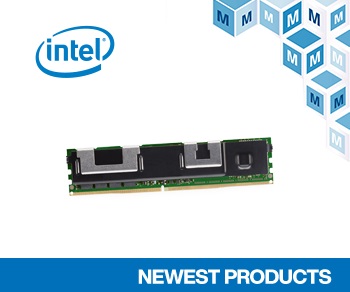
Mouser Electronics, Inc., the authorized global distributor with the newest semiconductors and electronic components, is now stocking Intel® Optane™ persistent memory, which provides an affordable alternative to DRAM with significantly increased capacity of up to 512 GBytes. Intel Optane offers increased performance and efficiency, helping to support applications such as in-memory databases, analytics, and content delivery networks.
Intel Optane persistent memory modules, available from Mouser Electronics, provide designers and developers with access to large, affordable memory capacity that can act as either volatile memory or a persistent, high-performance data tier. To simplify integration, the modules are DDR4 socket compatible and operate on the same bus/channels as DDR4 DRAM, enabling design flexibility when working with conventional DDR4 DRAM DIMMs on the same platform. The system’s administrator can configure Intel Optane persistent memory to operate as volatile memory capacity indistinguishable from DRAM from a software perspective, or as non-volatile memory that retains its data like an SSD, but at 225 times faster data access than a typical NAND-based drive.



Intel Optane persistent memory modules are available in capacities of 128 GBbytes, 256 GBytes, and 512 GBytes, and are compatible with the 2nd Generation Intel Xeon® Scalable processor family, allowing the development of up to eight-socket systems with up to 24 TBytes of system memory. The modules enable higher system performance with larger memory with much higher endurance than NAND SSDs for write-intensive workloads.
The versatile Intel Optane persistent memory features two operating modes — App Direct Mode and Memory Mode — allowing users to tailor their persistent memory solutions to specific workloads. Operating at the intersection of memory and storage, Intel Optane persistent memory supports the development of new data-intensive use cases, while also driving infrastructure consolidation by maximizing processor performance.
For more information, visit www.mouser.com

