

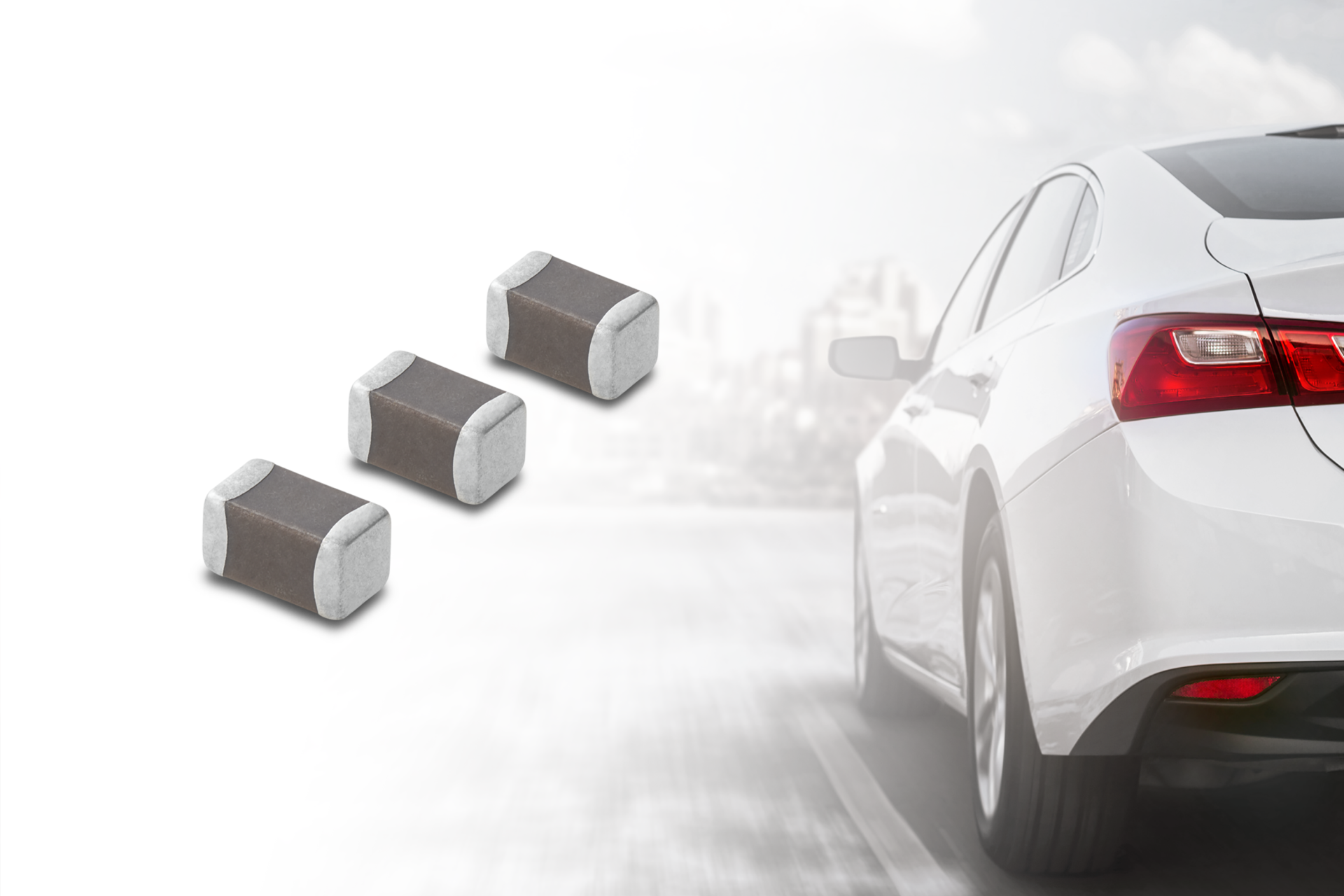
Murata Manufacturing Co., Ltd. introduces the GCJ21BD72A225KE02, a soft-termination chip multilayer ceramic capacitor (MLCC) for automotive powertrain and safety equipment. This world’s first soft-termination chip MLCC product achieves the highest available capacitance of 2.2μF at 100Vdc in the smallest 0805-inch (2.0×1.25mm) size.
As vehicle electrification accelerates and autonomous driving (AD) and advanced driver-assistance systems (ADAS) grow more sophisticated, engineers face increasing pressure to pack more functionality into tighter board spaces. The wider adoption of 48V power systems further demands components that combine high capacitance, high voltage tolerance, and a small footprint. At the same time, mechanical stress from board flexure, due to vibration and thermal cycling while driving, remains a reliability concern. The GCJ21BD72A225KE02 addresses all these challenges.



Built on Murata’s proprietary ceramic material design, including fine particle size and uniformity control, the soft-termination chip MLCC achieves 2.2μF at 100Vdc in the 0805-inch size, a rating previously only possible in the larger 1206-inch (3.2×1.6mm) size. The result is an approximately 51% reduction in board mounting area compared to Murata’s previous 2.2μF/100Vdc offering, and an approximately 2.2x increase in capacitance over its previous 0805-inch, 100Vdc product. Soft termination further enhances field reliability by absorbing board flexure stress and reducing post-mount cracking.
The GCJ21BD72A225KE02 supports an operating temperature range of -55°C to +125°C and meets X7T temperature characteristics per EIA standards. Murata will continue expanding its automotive-grade MLCC lineup, delivering the miniaturization, high capacitance, high voltage ratings, and reliability that next-generation vehicles demand.

