
HomeNewsIndia NewsA new path to non-toxic solid batteries

    A new path to non-toxic solid batteries

    Researchers have identified new solid materials that could lead to the manufacture of non-toxic lithium-ion batteries, according to a study recently published in the journal Science and Technology of Advanced Materials.

    Batteries are made of two oppositely charged electrodes separated by a liquid, gel-like, or solid ‘electrolyte’ medium through which electrically charged atoms, or ions, move. In many cases, these electrolytes are toxic and flammable, so researchers have been looking for non-toxic alternatives.


    Makoto Moriya of Shizuoka University in Japan investigated molecular crystals for this purpose. To obtain the crystals he added an organic compound to lithium salt. The molecules self-assembled to form channels through which lithium ions moved, creating an electric current. Changing the crystals’ structures affected their ion-conducting functions.
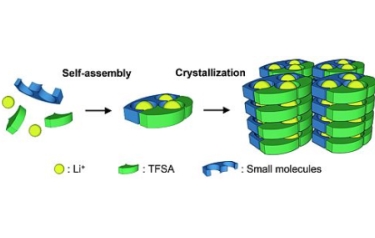
    When a specific organic compound is added to lithium salt, the molecules self-assemble to form channels through which lithium ions can move, creating an electric current.

    Ion conductivity in these materials was not as high as in organic liquids, inorganic ceramics or glass electrolytes. But it was comparable to polymer electrolytes, which have been targeted as potential solid electrolytes.

    Also, the amount of flammable organic substances in the molecular crystalline electrolytes was lower than in polymer electrolytes and in conventional liquid electrolytes, making them a potentially safer alternative.

    Moriya found it easy to control the crystal structure of these solid materials by making alterations to their molecules. This structural versatility could prove to be a powerful tool for dramatically improving ion conductivity in these materials.

    “These observations… could open the door to the design of new solid electrolytes and thus the development of new molecular devices,” Moriya concludes.

    ELE Times Bureau
    ELE Times Bureauhttps://www.eletimes.ai/
    ELE Times provides a comprehensive global coverage of Electronics, Technology and the Market. In addition to providing in depth articles, ELE Times attracts the industry’s largest, qualified and highly engaged audiences, who appreciate our timely, relevant content and popular formats. ELE Times helps you build awareness, drive traffic, communicate your offerings to right audience, generate leads and sell your products better.

    Related News

    Must Read

    Impact of AI on Computing and the Criticality of Testing

    Courtesy: Teradyne Artificial intelligence (AI) is transforming industries, enhancing our...

    Disruptions from Wide Bandgap Continue Turbulence

    Courtesy: Avnet When we experience major shifts in the technology...

    Securing Humanoid Robotics with TPM-Anchored FPGAs

    Courtesy: Lattice Semiconductor The humanoid robotics market is rapidly transitioning...

    Keysight Expands Digital‑Layer Error Performance Validation for High‑Speed 1.6T Interconnects in AI Data Centres

    Keysight Technologies, Inc. introduced the Functional Interconnect Test Solutions (FITS) portfolio...

    CEA-Leti and NcodiN Collaborate on 300 mm Silicon Photonics for Bandwidth-Consuming AI Interconnects

    CEA-Leti and NcodiN, a French deep-tech startup pioneering nanolaser-enabled...

    How good are ultra-low bitrate speech codecs?

    Courtesy: Rhode and Schwarz Quality Evaluation of Speech Coding Technologies A...

    NXP CoreRide Puts Automakers on Fast Path to 48 V Scalable Zonal Architectures

    NXP Semiconductors introduced its NXP CoreRide Z248 zonal reference...

    Microchip Helps Manufacturers Meet Cybersecurity Regulations, Expands Security Services in the Trust Platform

    As cybersecurity regulations tighten worldwide, product manufacturers must embed...

    Everspin Launches New Generation of Unified Memory for Embedded Systems

    Everspin Technologies, a leading developer and manufacturer of magnetoresistive...

