

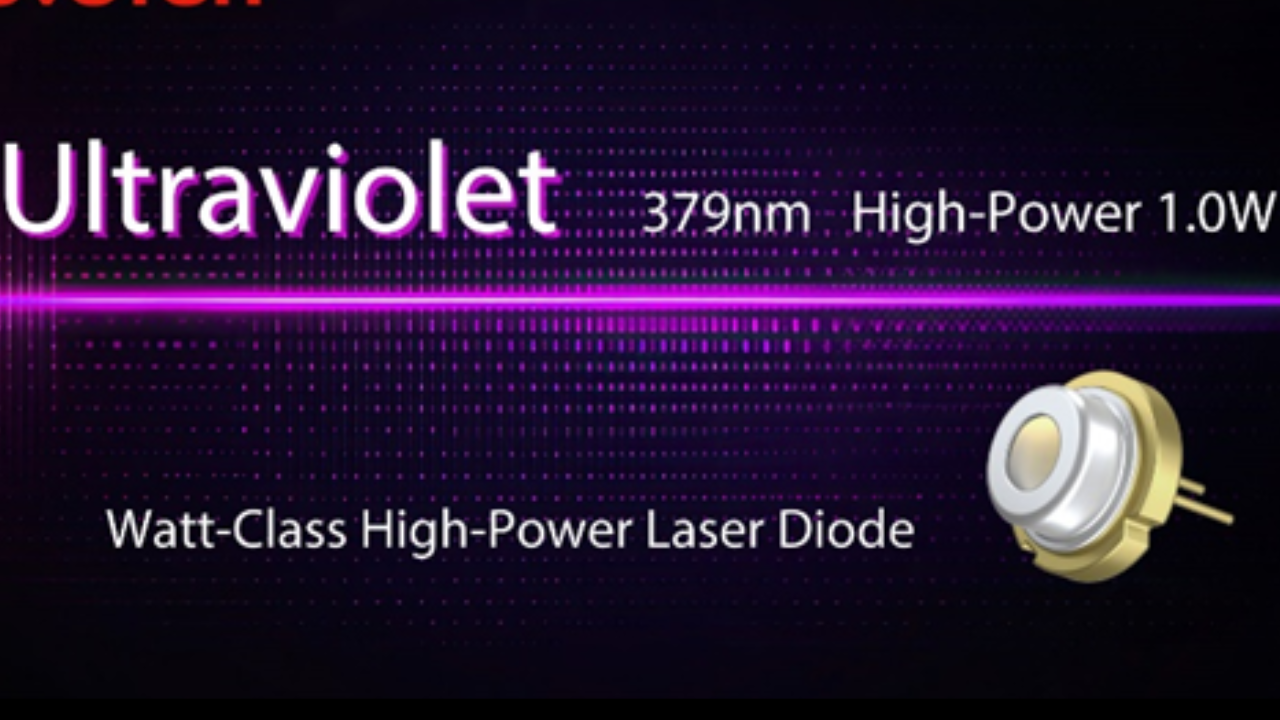
Nuvoton Technology announced the start of mass production of its high-power ultraviolet semiconductor laser (379 nm, 1.0 W) [1], which delivers industry-leading optical output in a 9.0 mm diameter CAN package (TO-9) [2]. This product achieves short wavelength, high output power, and long lifetime—three elements previously considered difficult for ultraviolet semiconductor lasers—through our proprietary device structure and advanced high-heat-dissipation packaging technology. As a result, it contributes to fine patterning and improved production throughput in maskless lithography [3] for advanced semiconductor packaging [4].
Achievements:



- Achieves 1.0 W-class optical output at 379 nm, contributing to fine patterning and improved production throughput in maskless lithography for advanced semiconductor packaging.
- Improves heat dissipation of ultraviolet semiconductor lasers through our proprietary device structure and packaging technology, suppressing device degradation from self-heat generation and ultraviolet light and contributing to the extended lifetime of optical equipment.
- Expands the lineup of mercury lamp replacement solutions [5], enhancing flexibility in product selection to suit different applications.
Features of New Product:
- Achieves 1.0 W-class optical output at 379 nm, contributing to fine patterning and improved production throughput in maskless lithography for advanced semiconductor packaging.
As demand grows for information processing capabilities driven by the evolution of artificial intelligence (AI), there is an increasing need for higher performance from semiconductors than ever before. On the other hand, as the miniaturisation of transistors approaches its physical and economic limits, semiconductor back-end package technologies and advanced semiconductor packaging, which allow for integration by arranging multiple semiconductor chips side by side or stacking them vertically, have been attracting attention.
In advanced semiconductor packaging, the mainstream method for forming wiring connections between multiple semiconductor chips has been exposure technology using the i-line (365 nm) of the mercury spectrum and photomasks (master masks of circuits). On the other hand, there has been growing interest in recent years in maskless lithography technology, which directly exposes (draws) wiring patterns based on design data without using photomasks.
This technology is considered to reduce the time and cost associated with the design and production of photomasks. Furthermore, because it is possible to directly imprint wiring patterns to match the surface shape of the target for drawing, alignment and correction are easier, and application to advanced semiconductor packages is currently under consideration.
As one of the key light sources in maskless lithography, semiconductor lasers have faced increasing demands for shorter wavelengths closer to the i-line (365 nm) and higher output, to enable finer wiring and improve equipment throughput. To meet these requirements, we have leveraged over 40 years of experience in laser design and manufacturing to develop and commercialise an ultraviolet semiconductor laser with a wavelength of 379 nm and an output of 1.0 W.
- Improves heat dissipation of ultraviolet semiconductor lasers through our proprietary device structure and packaging technology, suppressing device degradation from self-heat generation and ultraviolet light and contributing to the extended lifetime of optical equipment.
Ultraviolet semiconductor lasers generally suffer from significant heat generation caused by low wall-plug efficiency (WPE)[6], and a tendency for device degradation caused by ultraviolet light, making stable operation at high output levels above 1.0 W difficult to achieve. To address this, we took a dual approach by focusing on both a “device structure that enhances wall-plug efficiency (WPE)” and a “high thermal conduction package technology that effectively dissipates heat,” enabling us to develop a product that successfully combines short wavelength, high output, and long lifetime: a 1.0 W ultraviolet (379 nm) device. As a result, we are contributing to extending the lifetime of optical devices that utilise ultraviolet light.
・Device structure to enhance wall-plug efficiency
In addition to optimising the emission layer and optical guide layer, we have adopted a proprietary structure that precisely controls the doping profile. By reducing light absorption loss and operating voltage, this allows electrical energy to be converted into light more efficiently.
・High thermal conduction package technology that efficiently dissipates heat
In addition to adopting a submount made of high thermal conductivity materials, the package materials have been revised to reduce thermal resistance. As a result, rises in device temperature are suppressed, allowing for stable operation at high output.
- Expands the lineup of mercury lamp replacement solutions, enhancing flexibility in product selection to suit different applications.
This product has been newly added to our lineup of “semiconductor laser-based alternatives to mercury lamps,” providing customers with a new choice. With this addition, customers can flexibly select products according to application, installation environment, and required performance, thereby increasing the freedom of system design.
Details of this new product will be showcased at our booth at SPIE Photonics West 2026 in San Francisco, USA, and at OPIE’26 in Yokohama, Japan. We sincerely look forward to welcoming you.
Applications:
- Maskless lithography
・ Resin curing
・ Marking
・ 3D printing
・ Biomedical
・ Alternative light source for mercury lamps, etc.
Definitions:
[1] Ultraviolet semiconductor laser:
Our term is for a semiconductor laser that emits laser light with a peak wavelength of approximately 380 nm or less.
[2] TO-9 CAN:
CAN-type package with a diameter of 9.0 mm.
[3] Maskless lithography:
A technology that directly exposes photosensitive materials (resist) on a substrate based on design data without using a photomask and forms fine patterns. When using laser light, it is also referred to as Laser Direct Imaging (LDI).
[4] Advanced semiconductor packaging:
An implementation technology in which multiple semiconductor chips are densely integrated to optimise performance and power efficiency.
[5] Mercury lamp replacement solutions:
Nuvoton Technology’s lineup of semiconductor lasers is designed to replace the emission lines of mercury lamps: i-line (365 nm), h-line (405 nm), and g-line (436 nm). We propose the combined use of ultraviolet semiconductor lasers (379 nm), violet semiconductor lasers (402 nm), and indigo semiconductor lasers (420 nm).
[6] Wall-Plug Efficiency (WPE)
An indicator of the efficiency of converting electrical input into optical output. It is generally used to express the emission efficiency of semiconductor lasers.

