
The growth in the number of cars parked in urban areas has a major impact on Public Space. One key consequence of this is that parking availability is less predictable, both in downtown and in quieter, residential areas, where people are having to spend more and more time looking for a free space. One remedy is to create a residential parking zone. To justify this measure, however, a municipality must first commission reports and carry out a survey of parking availability, both of which take time and cost money.
To reduce this effort, the Fraunhofer Institute for Industrial Engineering IAO is now exploring the use of AI to analyze the demand for parking space. This pilot project is running in partnership with the City of Karlsruhe and is being conducted by the Research and Innovation Center for Cognitive Service Systems (KODIS), a branch of Fraunhofer IAO.



A promising mix of drones and AI
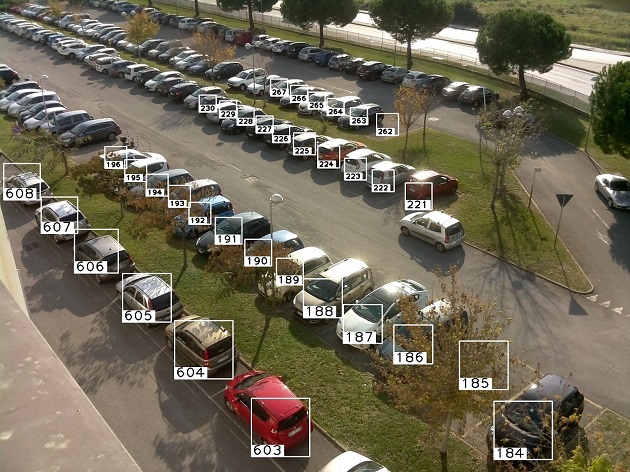
The project has already optimized the initial steps used to measure the demand for parking space. In place of the time-consuming business of collecting and entering data manually, camera drones are now being used to generate video images of the entire test area.
At the same time, improvements are also being made to data analysis, with AI being used in place of a manual evaluation of data. For this purpose, researchers are developing a deep-learning algorithm and training an artificial neural network to detect and precisely localize all the vehicles pictured in the images. In order to help the algorithm distinguish between parked and moving cars, the test area has been divided up into specific parking zones, which are linked to geospatial data. The algorithm then analyzes the images of a specific zone and marks all the vehicles parked there. On this basis, the system can determine the number of parked vehicles at any one time and thereby calculate the current utilization of parking space.
How public authorities can also profit from AI
The use of artificial intelligence is now widespread and generally accepted within the industrial environment. Its use to determine the demand for parking space is a nice example of how AI can also generate key benefits for municipalities. The algorithm developed for this project automatically calculates the utilization of parking space. This significantly reduces the time and costs required for manual data collection, with the result that parking problems in urban areas can be resolved much more swiftly.
In the future, Fraunhofer IAO would like to offer this AI-assisted system to municipalities as a digital cloud service. “Our automated analysis of aerial images will provide municipalities with a quick and cost-effective picture of street parking across an entire urban area,” says Dr. Bernd Bienzeisler, head of the Research and Innovation Center for Cognitive Service Systems at Fraunhofer IAO.

