
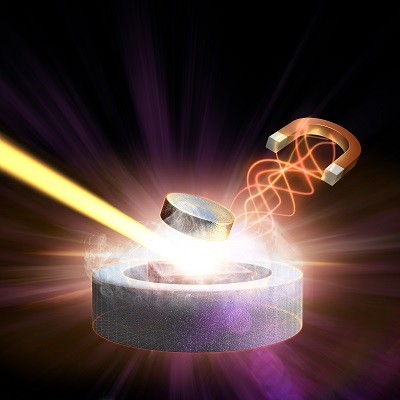
The physics world was set ablaze with the discovery that when an ultrathin layer of carbon, called Graphene, is stacked and twisted to a “magic angle,” that new double-layered structure converts into a superconductor, allowing electricity to flow without resistance or energy waste. Now, in a literal twist, Harvard scientists have expanded on that superconducting system by adding a third layer and rotating it, opening the door for continued advancements in graphene-based superconductivity.
Superconductivity in twisted graphene provides physicists with an experimentally controllable and theoretically accessible model system where they can play with the system’s properties to decode the secrets of high-temperature superconductivity,” said one of the paper’s co-lead authors Andrew Zimmerman, a postdoctoral researcher working in the lab of Harvard physicist Philip Kim.



Graphene is a one-atom-thick layer of carbon atoms that is 200 times stronger than steel yet is extremely flexible and lighter than paper. It has almost always been known to be a good conductor of heat and electrical current but is notoriously difficult to handle. Experiments unlocking the puzzle of twisted bilayer graphene have been ongoing since MIT physicist Pablo Jarillo-Herrero and his group pioneered the emerging field of “twistronics” with their experiment in 2018 where they produced the graphene superconductor by twisting it to a magic angle of 1.1 degrees.
One of those mechanisms has the theorists really excited. The trilayer system showed evidence that its superconductivity is due to strong interactions between electrons as opposed to weak ones. If true, this can not only help open a path to high-temperature superconductivity but possible applications in quantum computing.
While weakly interacting superconductors are fragile and lose superconductivity when heated to a few Kelvins, strong coupling superconductors are much more resilient but much less understood. Realizing strong coupling superconductivity in a simple and tunable system such as trilayer could pave the way to finally develop a theoretical understanding of strongly-coupled superconductors to help realize the goal of a high temperature, maybe even room temperature, superconductor.”

