
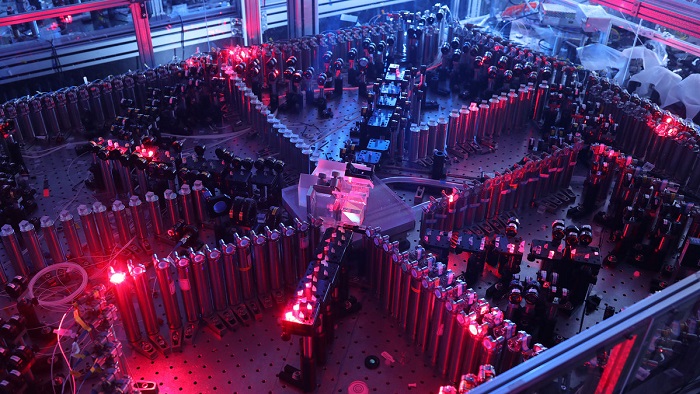
The collaboration of the School of Physics and Astronomy, of the University of Minnesota and Cornell University, has revealed some unique properties of a new semiconductor such as a superconducting metal. It has created a breakthrough in quantum computing and can be utilized in the nearby future. The metal is known as Niobium diselenide (NbSe2) that can conduct electricity or transport electrons or photons without any resistance. Quantum computing can reap the benefits of this new superconducting metal effectively and efficiently for new innovations.
Niobium diselenide is in 2D form with two-fold symmetry that makes it a more resilient superconductor. There are two types of superconductivity found in this metal— conventional wave-type consisting of bulk NbSe2 and unconventional d- or p- wave type for a few layers of NbSe2. These both have the same kind of energies due to the constant interaction and competition between each other. The research teams from both universities have combined the results of two different experimental techniques to generate this ground-breaking discovery. The scientists wanted to investigate the properties of NbSe2 further to able to use unconventional superconducting states to develop advanced quantum computers.




Superconducting metals, help to explore the boundaries between quantum computing and traditional computing with applications in quantum information. The quantum bits transform the functionalities of quantum computers with much higher speed than the traditional ones. Quantum bits exist in a superposition state along with two values 0 and 1 simultaneously with alpha and beta. Quantum computers require around 10,000 qubits to work smartly and help in the entanglement of nature’s mysteries. Superconductors can create a solid state of the qubit with quantum dots and single-donor systems. These superconductor metals are known for transforming electrons into a single superfluid that can move through a metal lattice without any resistance.
The discovery of 2D crystalline superconductors has opened a plethora of methods to investigate unconventional quantum mechanics. The top-notch quality of monolayer superconductor, NbSe2, is grown by chemical vapor deposition. The growth of these superconductors depends on the ultrahigh vacuum or dangling bond-free substrates that help to reduce environment and substrate-induced defects.
Hence, the world is waiting for further discoveries of some unique properties of any superconducting metal to help in the advancement of quantum computing that can bring certain breakthroughs in industries.

