
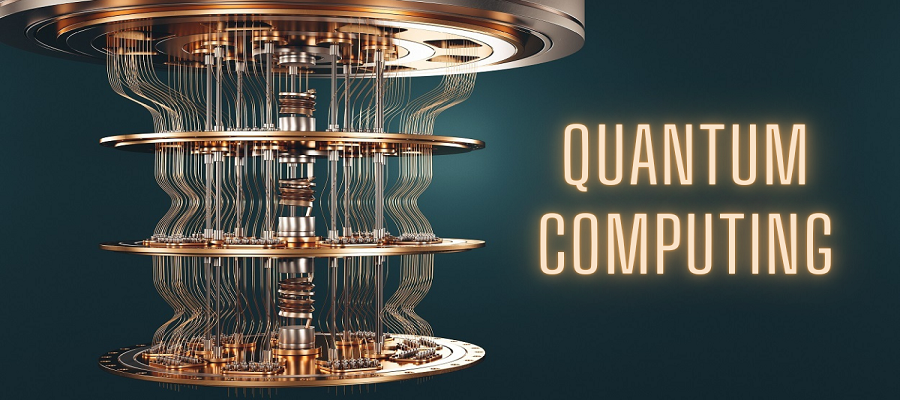
What is Quantum Computing?
Utilizing the ideas of quantum mechanics to carry out computations, quantum computing is a paradigm shift in computing. Quantum computers employ quantum bits, or qubits, which can exist in numerous states concurrently due to the laws of superposition and entanglement. This is in contrast to classical computers, which use bits as binary units (0 or 1).




Quantum Computing History
Physicist Richard Feynman first introduced the idea of quantum computing in the early 1980s as a way to emulate quantum systems. David Deutsch later came up with the name “quantum computing” in 1985. But the first quantum algorithms, like Grover’s and Shor’s, didn’t show off the potential capabilities of quantum computing until the late 1990s.
Types of Quantum Computing
Although there are many ways to create quantum computers, gate-based quantum computing and quantum annealing are the two primary varieties. Quantum gates are used by gate-based quantum computers, like those made by Google and IBM, to control qubits. D-Wave and other quantum annealers use quantum annealing to solve optimization issues.
How Does Quantum Computing Work?
The concepts of superposition and entanglement are used in quantum computing to carry out intricate calculations. Because qubits can exist in several states at once, quantum computers can process enormous volumes of data at once. Qubits are manipulated by quantum gates to carry out operations, and the outcome is determined by measuring the final state.
Quantum Computing Applications
Quantum computing holds promise for a wide range of applications, including:
- Cryptography: Quantum computers can potentially break widely used encryption algorithms, prompting the need for quantum-resistant cryptographic methods.
- Optimization: Quantum computing excels at solving complex optimization problems, such as route optimization for logistics or portfolio optimization in finance.
- Drug Discovery: Quantum computers can simulate molecular structures and interactions, accelerating drug discovery processes.
- Machine Learning: Quantum computing has the potential to enhance machine learning algorithms, offering speed-ups in training and solving certain problems.
Quantum Computing Technology
Technologies for quantum computing are being actively developed by several businesses and academic institutes. IBM, Google, Microsoft, Rigetti, IonQ, and D-Wave are some of the major participants. Usually kept in specially designed buildings with extremely low temperatures to minimize interference from outside sources, quantum computers are stored there.
Quantum Computing Advantages
- Parallelism: Quantum computers can process multiple possibilities simultaneously, providing a potential for exponential speed-up in certain computations.
- Problem Solving: Quantum computers excel at solving complex problems that are practically intractable for classical computers.
Quantum Computing Disadvantages
- Error Rates: Qubits are susceptible to errors due to environmental factors, requiring sophisticated error correction techniques.
- Decoherence: The delicate quantum states of qubits can be easily disturbed, leading to a loss of information.
Future of Quantum Computing
Quantum computing has immense potential for revolutionary developments in the future. Researchers work to address issues like mistake rates and scalability as technology advances. It is already possible for quantum computers to achieve quantum supremacy, wherein they surpass classical computers in specific tasks. It is anticipated that further advancements in quantum hardware and algorithms will open up new avenues and influence the direction of computing in the future.
In conclusion, quantum computing is an exciting new area of technology that has the potential to completely transform several different sectors. Even while quantum computing is still in its infancy, its quick development and growing interest from academia and industry point to a bright future. We may expect a quantum leap in computational power and efficiency as long as researchers keep overcoming obstacles.

