
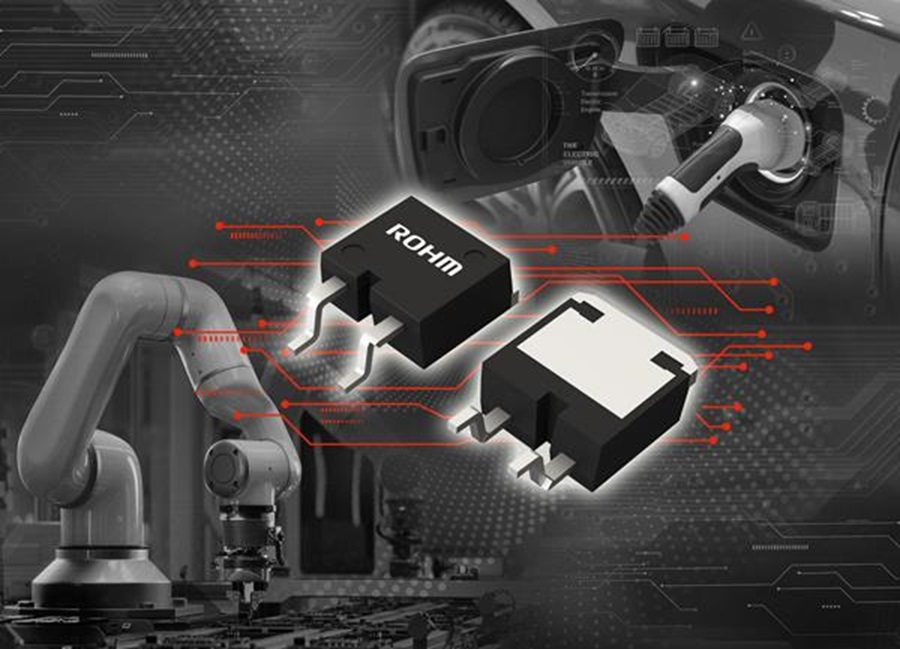
Achieves approx. 1.3 times the creepage distance compared to standard products.
ROHM has developed surface mount SiC Schottky barrier diodes (SBDs) that improve insulation resistance by increasing the creepage distance between terminals. The initial lineup includes eight models – SCS2xxxNHR – for automotive applications such as onboard chargers (OBCs), with plans to deploy eight models – SCS2xxxN – for industrial equipment such as FA devices and PV inverters in December 2024.




The rapidly expanding xEV market is driving the demand for power semiconductors, among them SiC SBDs, that provide low heat generation along with high-speed switching and high-voltage capabilities in applications such as onboard chargers. Additionally, manufacturers increasingly rely on compact surface mount devices (SMDs) compatible with automated assembly equipment to boost manufacturing efficiency. Compact SMDs tend to typically feature smaller creepage distances, fact that makes high-voltage tracking prevention a critical design challenge.
As leading SiC supplier, ROHM has been working to develop high-performance SiC SBDs that offer breakdown voltages suitable for high-voltage applications with ease of mounting. Adopting an optimized package shape, it achieves a minimum creepage distance of 5.1mm, improving insulation performance when contrasted with standard products.
The new products utilize an original design that removes the center pin previously located at the bottom of the package, extending the creepage distance to a minimum of 5.1mm, approx. 1.3 times greater than standard products. This minimizes the possibility of tracking (creepage discharge) between terminals, eliminating the need for insulation treatment through resin potting when surface mounting the device on circuit boards in high voltage applications. Additionally, the devices can be mounted on the same land pattern as standard and conventional TO-263 package products, allowing an easy replacement on existing circuit boards.
Two voltage ratings are offered, 650V and 1200V, supporting 400V systems commonly used in xEVs as well as higher voltage systems expected to gain wider adoption in the future. The automotive-grade SCS2xxxNHR are AEC-Q101 qualified, ensuring they meet the high reliability standards this application sector demands.
Going forward, ROHM will continue to develop high-voltage SBDs using SiC, contributing to low energy consumption and high efficiency requirements in automotive and industrial equipment by providing optimal power devices that meet market needs.
Terminology
Creepage Distance
The shortest distance between two conductive elements (terminals) along the surface of the device package. In semiconductor design, insulation measures with such creepage and clearance distances must be taken to prevent electric shocks, leakage currents, and short-circuits in semiconductor products.
Tracking (Creepage Discharge)
A phenomenon where discharge occurs along the surface of the package (insulator) when high voltage is applied to the conductive terminals. This can create an unintended conductive path between patterns, potentially leading to dielectric breakdown of the device. Package miniaturization increases the risk of tracking by reducing creepage distance.
Resin Potting
The process of encapsulating the device body and the electrode connections between the device and circuit with resin, such as epoxy, to provide electrical insulation. This provides durability and weather resistance by protecting against water, dust, and other environmental conditions.
AEC-Q101 Automotive Reliability Standard
AEC stands for Automotive Electronics Council, a reliability standard for automotive electronic components established by major automotive manufacturers and US electronic component makers. Q101 is a standard that specifically applies to discrete semiconductor products (i.e. transistors, diodes).

