
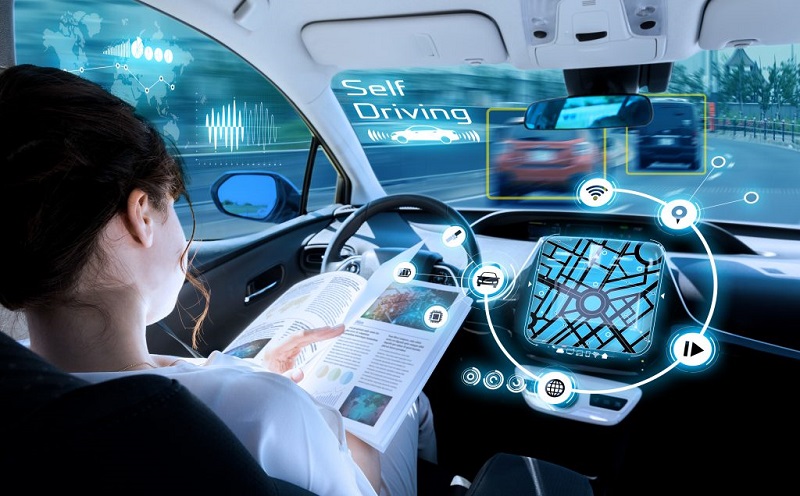
A team of researchers has developed a new early warning system for vehicles that uses artificial intelligence to learn from thousands of real traffic situations. A study of the system was carried out in cooperation with the BMW Group. The results show that, if used in today’s self-driving vehicles, it can warn seven seconds in advance against potentially critical situations that the cars cannot handle alone—with over 85% accuracy.
To make self-driving cars safe in the future, development efforts often rely on sophisticated models aimed at giving cars the ability to analyze the behavior of all traffic participants. But what happens if the models are not yet capable of handling some complex or unforeseen situations?



Thanks to artificial intelligence (AI), their system can learn from past situations where self-driving test vehicles were pushed to their limits in real-world road traffic. Those are situations where a human driver takes over—either because the car signals the need for intervention or because the driver decides to intervene for safety reasons.
Pattern recognition through RNN
The technology uses sensors and cameras to capture surrounding conditions and record status data for the vehicle such as the steering wheel angle, road conditions, weather, visibility, and speed. The AI system, based on a recurrent neural network (RNN), learns to recognize patterns with the data. If the system spots a pattern in a new driving situation that the control system was unable to handle in the past, the driver will be warned in advance of a possible critical situation.
To make vehicles more autonomous, many existing methods study what the cars now understand about traffic and then try to improve the models used by them. The big advantage of this technology: they completely ignore what the car thinks. Instead, we limit ourselves to the data based on what actually happens and look for patterns. In this way, the AI discovers potentially critical situations that models may not be capable of recognizing, or have yet to discover. The system, therefore, offers a safety function that knows when and where the cars have weaknesses.
Warnings up to seven seconds in advance
The team of researchers tested the technology with the BMW Group and its autonomous development vehicles on public roads and analyzed around 2500 situations where the driver had to intervene. The study showed that the AI is already capable of predicting potentially critical situations with better than 85 percent accuracy—up to seven seconds before they occur.
Collecting data with no extra effort
For the technology to function, large quantities of data are needed. After all, the AI can only recognize and predict experiences at the limits of the system if the situations were seen before. With a large number of development vehicles on the road, the data was practically generated by itself. Every time a potentially critical situation comes up on a test drive, They end up with a new training example. The central storage of the data makes it possible for every vehicle to learn from all of the data recorded across the entire fleet.

