

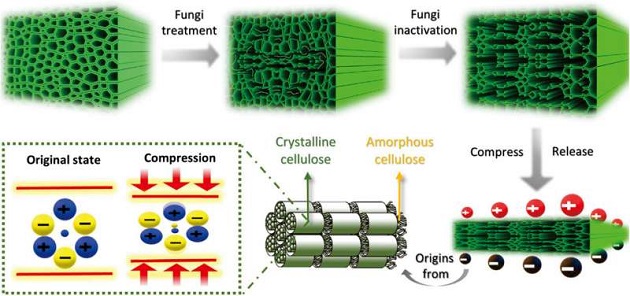
A multi-institutional team of researchers has found that it is possible to use a type of fungus to soften wood to the point that it could be used to generate electricity. In their paper published in the journal Science Advances, the group describes their process and how they tested it.
As the world works its way toward cleaner energy-producing systems, scientists seek novel approaches to producing electricity. One possibility is the use of piezoelectric devices that generate electricity by harnessing movement such as footsteps. In this new effort, the researchers have noted that much energy is wasted when people walk around. And while some have attempted to harness some of that energy with devices designed for shoes or legs, the researchers with this new effort wondered if it might be possible to add piezoelectrics to the floor to make use of that energy.



In studying the kinds of wood that are used to make floors, particularly in homes, the researchers noted that they do not have much give—a necessary component of an energy-harvesting system. To solve that problem, they found that applying a type of white rot fungus to pieces of balsa wood for a few weeks sped up the decaying process in a useful way. It made the wood spongier, which translated to give. When stepping on the wood, the researchers could feel it depress. They also found that after the wood returned to its former shape when pressure was removed.
To test their idea, the researchers treated a wooden veneer with the fungus and then added a piezoelectric device, which sent the power it produced through a wire attached to an LED light. The wood was then placed on a floor where people could walk on it. Each time they did so, the light came on. The researchers note that the amount of electricity generated was just 0.85 volts but the system could very easily be scaled up to include all the flooring in a home, generating enough electricity, perhaps, to power certain devices.

