

Machine learning architecture means the designing and organizing of all of the components and processes that constitute an entire machine learning system. The ML Architecture lays down the framework to design machine learning systems, indicating how data is to be handled, models to be built and analyzed, and predictions to be made. Depending on the particular use case and the set of requirements, the architecture can vary.
A highly scalable and performant machine learning system can be realized through proper architecture.




Types of Machine Learning Architecture:
- Supervised Learning Architecture Unsupervised Learning Architecture
By definition, Supervised Learning uses labeled data to train models: this means each input has a corresponding correct output value. The supervised learning architecture begins with gathering the datasets-full labeled, then undergoes Data Preprocessing to make sure the labels match up with the inputs correctly. Afterward, with the data ready, it proceeds to training it with the algorithm, like Linear Regression, Logistic Regression, SVM, or Random Forests. This method is very suitable when making predictions like: House Price Predictions, Email classifications as Spam or Not Spam, Medical diagnoses based on test results. Supervised learning’s primary benefit is its excellent accuracy when given clean, properly labelled data. It necessitates a lot of labelled data, though, and its preparation can be costly and time consuming.
- Unsupervised Learning Architecture
In unsupervised learning, unlabeled data is used. Hence, the system tries to find the patterns or the clusters without much explicit guidance. Data acquisition for this architecture is more flexible because no labels are required. Preprocessing, however, serves a vital purpose in ensuring the data is consistent and meaningful. Algorithms used in unsupervised learning include K-Means Clustering, Hierarchical Clustering, and PCA. This approach is applicable in customer segmentation, anomaly detection, or market basket analysis. The biggest attraction for unsupervised systems is that they work on data that is generally easier to come by. But since results fundamentally depend on pattern discovery, interpretation of such results may require domain knowledge.
- Reinforcement learning
Reinforcement learning is based on the principle of learning through the interaction with an environment. The architecture is designed to have a setting representing the environment, where a model will choose an action and get feedback on that action being rewarded or penalized. This feedback interchanges are insect within the structure that meanwhile allows model improvement from trial and error. Some popular algorithms are Q-Learning, Deep Q-Networks (DQN), and Policy Gradient methods.
Reinforcement learning finds its way into robots, game AI, and autonomous systems. Its strongest suit is adapting to a dynamic environment wherein the reward is a function of a series of other actions. Hence training can take ages and require a lot of computing power.
Machine Learning Architecture Diagram:
An overview of the many different parts required to create a machine learning application is given by a machine learning architecture diagram.
Simple Machine Learning Architecture Diagram:
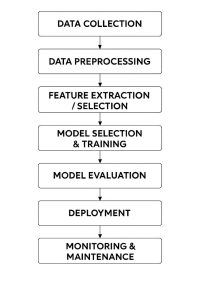
Explanation of the Machine Learning Architecture Diagram:
The diagram outlines the step-by-step process of building and running a machine learning system.
- Data Collection – It helps to treat data as raw material that comes to the project from some arbitrary source like a data base, sensor, API, or web scraping.
- Data Preprocessing – Raw data are often incomplete or inconsistent. In this stage, the data are cleaned and formatted and then prepared so that the model understands them. This is a stage of utmost importance for accuracy.
- Feature Extraction / Selection – Some data is never as useful as others. Herein, the most important variables (features) that determine predictions are picked and retained while other ones that are irrelevant are discarded.
- Model Selection & Training – The type of problem being solved will determine the algorithm choice; the model is then fitted with the historical data to learn patterns and relationships.
- Model Evaluation – The model is tested on new data to assess its accuracy, efficiency, and ability to make real predictions.
- Deployment – Once the model works fine, it is incorporated into a live application or system for real-time prediction or decision-making.
- Monitoring & Maintenance – The model goes through performance tracking as time passes by. It shall be updated or re-trained every time its accuracy is compromised due to real-world data change.
The feedback loop often sends the process to the earlier stages due to new data, ensuring the improvement of the model all the time.
Conclusion:
Machine Learning architecture is more than just a technical plan it is a backbone that decides how well an ML system learns, adapts to changes, and gives out results. A bad architecture disrupts data flow, creates delays in training, and compromises the reliability of predictions over time. Properly-designed ML architectures can be used by businesses and researchers to address problems accurately and at scale. As data grows and technologies evolve, these architectures shall continue to be the power that fuels innovations that re-shape industries by helping people make better decisions while changing everyday life.

