
ST is announcing the availability of the STM32G491 and STM32G4A1 microcontrollers. The new members of the STM32G4 Access Line offer increased memory capacity with 112 KB of RAM and up to 512 KB of Flash, compared to the 32 KB of RAM and 128 KB of Flash of the STM32G431, the flagship of the Access Line until now. Furthermore, the only difference between the STM32G491 and STM32G4A1 is the presence of a crypto core on the latter. Indeed, both serve a highly symbolic purpose as they open the STM32G4 series to new cost-effective applications without compromising performances thanks to its Cortex-M4 running at 170 MHz. What may have previously required an STM32G0 with external analog components can now benefit from the new STM32G4s. Hence, by launching the STM32G491 and STM32G4A1, we provide new solutions to engineers working on cost-effective motor control systems.
STM32G491, STM32G4A1: Increasing the Reach of the STM32G4 in Cost-Effective Applications
STM32G4 and the STM32H7
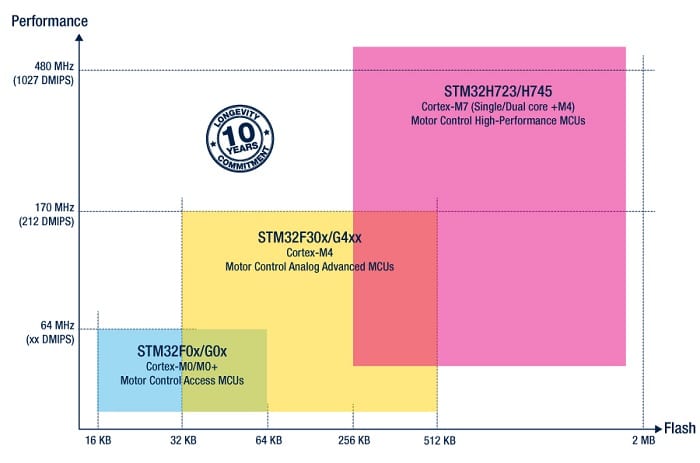
Launched in mid-2019, the STM32G4 is a mixed-signal microcontroller with high-resolution timers and a math accelerator. The high-resolution timer and FMAC (Filter Math ACcelerator) are useful for digital power applications. On the other hand, Motor Control timers and CORDIC math accelerator optimize motor control systems. The STM32G4 remains a general-purpose MCU in the strict sense of the term, meaning that it will support any embedded system meant to run on a Cortex-M4 and supported by a generic STM32 ecosystem. However, it also targets precise applications by providing analogue and digital peripherals or features usually absent from similar general-purpose MCUs.




This approach is highly popular, and the STM32G4 series even manages to blur the line between the STM32G4 and the High-Performance STM32F4 or the STM32H7. Indeed, teams don’t necessarily have to adopt the latter if they wish to create a high-performance motor or power application. The STM32G4 has enough computational throughput to satisfy developers that don’t need all the power or features of the STM32H7.
STM32G4 and STM32G0
Similarly, engineers are now looking to use the STM32G4 in more cost-effective motor control systems. However, until now, the only solution was to use an STM32G0 with external analog components. The latter is excellent for cost-oriented customers, but there was still a need for STM32G4s with more performance and analog integration. Indeed, companies already using this series may be looking to benefit from a volume discount or faster qualification processes. Other engineers may also want to enjoy the pin-to-pin compatibility with other STM32G4 models to hasten their development. Finally, teams may miss the math accelerator, absent from the STM32G0. Hence, developers looking for more memory had to get an STM32G47x with more features than necessary. The new models solve this challenge.
STM32G491, STM32G4A1: Improving Accessibility While Offering a Myriad of Peripherals
The Access Line Specifications

The STM32G491 and STM32G4A1 adopt a similar architecture as the other member of the Access Line series. As a result, the microcontrollers do not offer high-resolution timers since engineers only need them for digital power systems. However, they do have the USB-C PD controller, two FDCAN interfaces, and a slew of other communication peripherals. Engineers will also find three fast 12-bit ADCs with gain and offset compensation to offload the CPU. The new models also include four operational amplifiers, four DAC channels, four ultra-fast comparators, and more. Hence, ST ensured that engineers still had access to many peripherals, which is one of the MCU’s most significant appeal, while making the STM32G4 more accessible.
NUCLEO-G491RE
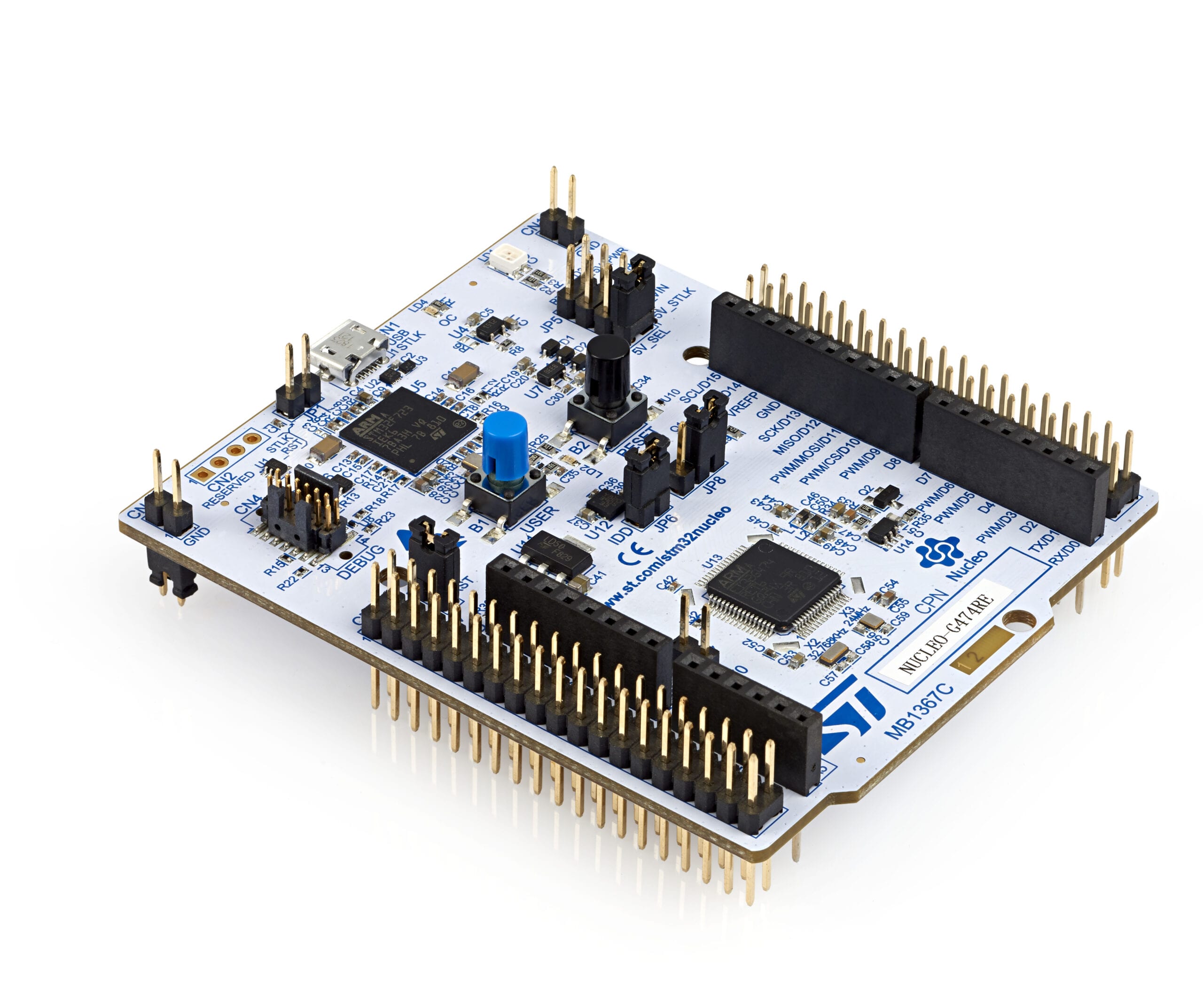
To ensure engineers can try the new STM32G4s rapidly, ST is releasing the NUCLEO-G491RE. The Nucleo board uses the STM32G491 with 512 KB of flash, allowing teams to test the highest storage configuration. Developers can then evaluate whether they need all this storage or use the STM32G491 and STM32G4A1 with less flash. In fact, we already updated our user manual and STM32Cube ecosystem to help developers get started.
For more information, visit blog.st.com

